


Introduction
Converting V to watts is a common electrical calculation when choosing power supplies, sizing electrical equipment, comparing appliances, or determining how much power a circuit can deliver. However, volts alone do not tell you how many watts a device uses. To calculate electrical power accurately, you generally need to know the voltage and current, measured in amperes (amps), and sometimes the power factor.
The good news is that the calculation is straightforward once you understand the relationship between voltage, current, and power. Whether you are working with a 5V USB charger, a 12V battery, a 24V power supply, or a standard household electrical circuit, the right formula helps you get a reliable answer without guesswork.
This guide explains how V to watts conversion works, which formulas to use for DC and AC electricity, how to calculate common voltage values, and what to check before selecting electrical equipment.
What Does V to Watts Mean?
The term V to watts describes the process of calculating electrical power from a voltage value. The letter V stands for volts, the unit used to measure electrical potential difference, while the watt (W) measures the rate at which electrical energy is transferred or consumed.
These units measure different properties of electricity. Voltage represents the electrical potential that drives current through a circuit, whereas watts describe how quickly energy is being used or delivered.
For example, a 12V power supply does not automatically produce 12 watts. If it supplies 2 amps to a compatible load, its DC output power is 24 watts.
Understanding this distinction prevents a common mistake: assuming that a voltage number can be converted directly into watts without additional information.
Volts vs. Watts vs. Amps
| Electrical unit | Symbol | What it measures |
|---|---|---|
| Volts | V | Electrical potential difference |
| Watts | W | Electrical power |
| Amperes | A | Electrical current |
| Ohms | Ω | Electrical resistance |
| Kilowatts | kW | Power equal to 1,000 watts |
| Kilowatt-hours | kWh | Energy consumed over time |
Think of voltage as the electrical pressure that encourages current to flow. Current is the flow of electric charge, while power describes the rate at which electrical energy is transferred.
These quantities are related, but they are not interchangeable. To convert V to watts, you need enough additional information to determine the power.
V to Watts Conversion Formula
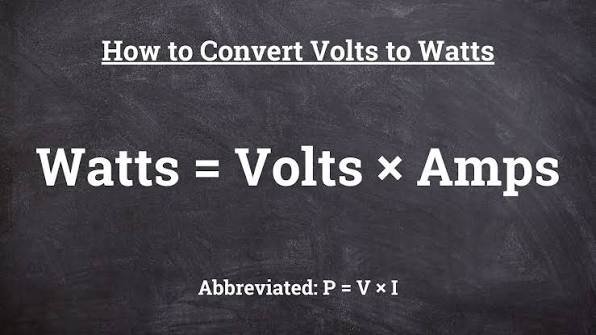
The most important formula for converting voltage to watts is:
Where:
-
\(P\) = electrical power in watts (W)
-
\(V\) = voltage in volts (V)
-
\(I\) = current in amperes (A)
This formula applies directly to DC circuits and to AC circuits when the appropriate conditions are met, such as a purely resistive load or a power factor of 1.
How to Convert V to Watts Step by Step
Follow these three steps to calculate power:
-
Find the voltage: Check the device label, power supply specifications, or measurement.
-
Find the current: Look for the amperage rating in amps (A). Make sure you know whether the value represents actual operating current or a maximum rating.
-
Multiply volts by amps: Use the formula \(P=V\times I\) to calculate watts.
Example: Suppose a device operates at 12 volts and draws 3 amps.
The electrical power is 36 watts, assuming DC operation or suitable AC conditions.
Why You Cannot Convert Volts to Watts Directly
There is no universal conversion factor between volts and watts because voltage and power measure different things. A 24V circuit carrying 0.5 amps delivers 12 watts, while a 24V circuit carrying 5 amps delivers 120 watts.
Both circuits have the same voltage, but their power levels differ by a factor of ten. The current is the missing piece of information.
If you know only the voltage, you can calculate watts only when you have additional information, such as current, resistance, or sufficient AC circuit data.
V to Watts Conversion Table
The following table shows the power produced at different voltages and current levels using the basic formula \(P=V\times I\).
| Voltage | At 0.5 A | At 1 A | At 2 A | At 5 A |
|---|---|---|---|---|
| 5V | 2.5W | 5W | 10W | 25W |
| 9V | 4.5W | 9W | 18W | 45W |
| 12V | 6W | 12W | 24W | 60W |
| 19V | 9.5W | 19W | 38W | 95W |
| 24V | 12W | 24W | 48W | 120W |
| 48V | 24W | 48W | 96W | 240W |
| 120V | 60W | 120W | 240W | 600W |
| 230V | 115W | 230W | 460W | 1,150W |
These are calculated power values, not guaranteed appliance consumption figures. The table assumes the listed current actually flows through the load and that the simple voltage-current relationship is appropriate.
For AC circuits, the table should not be interpreted as a universal real-power table because the power factor can change the relationship between voltage, current, and watts.
How to Convert Common Voltages to Watts
The following examples demonstrate how to calculate power for commonly used electrical voltages. Each example includes the current needed to determine the wattage.
5V to Watts
A 5V supply is common in USB-powered electronics, small sensors, and some development boards.
If a device draws 2 amps:
Therefore, 5V at 2A equals 10W under the stated conditions.
A 5V supply rated for 3A has a maximum theoretical output of 15W, but a connected device may consume much less.
12V to Watts
Twelve-volt systems are widely used in automotive electronics, LED lighting, routers, and battery-powered equipment.
For a 12V device drawing 5A:
The result is 60 watts.
For a battery-powered system, remember that voltage can vary with the battery’s charge level, and current depends on the connected equipment. The actual power may therefore change during operation.
24V to Watts
A 24V supply is frequently used in industrial controls, networking equipment, and certain lighting systems.
Suppose the connected equipment draws 4A:
The calculated power is 96 watts.
When selecting a 24V supply, check both its voltage compatibility and its current capacity. A supply rated for 24V and 5A can theoretically deliver 120W, but operating margin, temperature, and manufacturer specifications also matter.
48V to Watts
Forty-eight-volt systems appear in telecommunications, networking equipment, and some battery and power-distribution applications.
For a load drawing 2.5A:
Therefore, 48V at 2.5A equals 120W under the stated conditions.
Higher voltage can reduce current for the same power, which may help reduce cable losses. However, the wiring, connectors, insulation, and protection devices must be suitable for the system’s voltage and current.
120V to Watts
A 120V supply is used in some residential and commercial electrical systems.
If a compatible load draws 10A and has a power factor of 1:
The real power is 1,200 watts, or 1.2kW.
For an AC appliance with a power factor below 1, the real power will be lower than the simple voltage-times-current product.
230V to Watts
A 230V supply is common in many countries for household and commercial equipment.
If a resistive appliance draws 5A:
The appliance uses approximately 1,150 watts at those operating conditions.
For a motor, compressor, or other non-resistive AC load, use the appropriate power factor and circuit configuration rather than assuming that 230V multiplied by the current always equals real power.
How to Calculate Watts From Volts and Amps
The simplest way to calculate electrical power is to multiply voltage by current. However, it is important to distinguish between a device’s rated values and the amount of electricity it actually uses.
Consider a power supply marked 12V, 4A. Multiplying these values gives a maximum nominal output of 48W if the supply can provide its full rated current at 12V.
That does not mean a connected device constantly consumes 48W. If the device draws only 1.5A at 12V, its power consumption is:
This distinction is especially useful when choosing chargers, adapters, and battery systems. The power supply’s rating describes its capacity, while the connected load determines the actual demand within normal operating conditions.
Calculate Watts From Resistance Instead
If you know voltage and electrical resistance but not current, you can use another formula derived from Ohm’s law:
Where \(R\) is resistance in ohms.
For example, a 12V source connected to a 6Ω resistive load produces:
The calculated power is 24 watts.
This method is useful for ideal resistive DC circuits. For AC circuits, impedance and phase relationships may require a more detailed calculation.
V to Watts for DC and AC Electricity
One of the most important parts of accurate power conversion is knowing whether you are working with direct current (DC) or alternating current (AC). The basic relationship between voltage, current, and power remains important in both systems, but AC calculations may require extra information.
DC Power Formula
DC electricity flows with a fixed polarity, as in a battery-powered circuit or the output of many DC adapters.
For a DC circuit:
For example, a 24V DC motor drawing 3A has an electrical input power of:
This represents electrical input power, not necessarily mechanical power delivered by the motor. Some energy is lost as heat and through other inefficiencies.
Single-Phase AC Power Formula
For a single-phase AC circuit, real power depends on voltage, current, and power factor:
Here, \(PF\) stands for power factor, a value that describes the relationship between real power and apparent power.
Suppose a 230V appliance draws 4A and has a power factor of 0.8:
The appliance consumes 736W of real power under these assumed operating conditions.
Multiplying 230V by 4A alone gives 920 volt-amperes (VA), which is apparent power rather than real power.
Three-Phase AC Power Formula
Three-phase systems are common in industrial equipment, commercial buildings, and larger motors.
For a balanced three-phase system using line-to-line voltage and line current:
Where:
-
\(V_L\) = line-to-line voltage
-
\(I_L\) = line current
-
\(PF\) = power factor
For example, a balanced three-phase load operating at 400V, drawing 10A, with a power factor of 0.85 has a real power of approximately:
The calculated real power is approximately 5.89kW.
This formula assumes a balanced system and the stated voltage and current definitions. Unbalanced loads and unusual waveforms can require more detailed methods.
V to Watts Calculator: Calculate Power in Seconds
You can calculate power quickly using the formula below. Enter your voltage and current to obtain the result for a DC circuit or a circuit where the simple voltage-current formula applies.
V to Watts Calculator
For single-phase AC, enter the power factor. For DC, it is not required.
Calculated real power
24 W
Equivalent to 0.024 kW.
Formula: P = V × I
Important: This calculator assumes a DC circuit or single-phase AC circuit with a known power factor. It does not calculate three-phase power, and its result does not account for power-supply conversion losses.
Common Mistakes When Converting V to Watts
A correct formula is only useful when the input values and assumptions are correct. These are some of the most frequent errors to avoid.
1. Treating Volts as Watts
A 12V device is not automatically a 12W device. You need the current or other suitable circuit information to determine its power.
2. Ignoring the Power Factor in AC Circuits
For AC equipment, multiplying RMS voltage by RMS current gives apparent power in VA. Real power in watts depends on the power factor, so ignoring it can produce an incorrect result.
3. Confusing Rated Power With Actual Consumption
A 100W power adapter does not force every connected device to consume 100W. The connected equipment draws the power it requires, provided the adapter and device operate within their specifications.
4. Mixing Up Watts and Watt-Hours
Watts measure the rate of energy use, while watt-hours measure energy accumulated over time.
For example, a device using 100W continuously for 5 hours consumes:
That equals 0.5kWh. It does not mean the device uses 500W.
5. Forgetting Efficiency Losses
A power supply that delivers 60W to a device may draw more than 60W from the wall because some input energy is lost as heat.
If its efficiency is 90%, the approximate input power required to deliver 60W is:
The 60W figure is output power, while approximately 66.7W is input power under the assumed efficiency.
Practical Applications of V to Watts Conversion
Knowing how to convert voltage and current into watts can help with several everyday and professional tasks.
-
USB chargers: Check whether a charger can supply the power required by a compatible device. USB charging power may vary with supported voltage and current profiles.
-
Battery systems: Estimate the electrical power delivered to a DC load and use watt-hours to estimate energy capacity and runtime.
-
LED lighting: Calculate the electrical power drawn by a strip or lighting circuit using its operating voltage and current.
-
Solar power systems: Compare panel output, controller ratings, and connected loads while allowing for changing sunlight and conversion losses.
-
Power supplies: Match the supply’s output voltage and current capacity to the equipment’s requirements.
-
Electrical appliances: Estimate real power and energy consumption, using suitable AC calculations where needed.
For battery planning, a useful starting point is:
A battery with 240Wh of usable energy could theoretically run a 40W load for 6 hours. Actual runtime may be shorter because of conversion losses, temperature, battery condition, and limits on usable capacity.
How to Check Electrical Ratings Safely
Before applying a V to watts calculation to real equipment, check the product label and manufacturer’s specifications.
-
Confirm whether the listed voltage is AC or DC.
-
Check whether current is a typical operating value or a maximum rating.
-
For AC equipment, identify whether the current and power figures refer to real or apparent power.
-
Verify that power supplies, cables, connectors, and protection devices are rated for the intended application.
-
Avoid exceeding the equipment’s specified voltage, current, or temperature limits.
Do not measure live mains electricity unless you are qualified and equipped to do so safely. For uncertain wiring, high-current systems, or three-phase equipment, consult a qualified electrician.
Frequently Asked Questions About V to Watts
1. How do you convert V to watts?
To convert V to watts, multiply voltage by current when working with DC electricity or an applicable circuit with a power factor of 1. The formula is \(P=V\times I\). For example, 12V multiplied by 2A equals 24W.
For AC equipment with a power factor below 1, calculate real power using \(P=V\times I\times PF\) for a single-phase circuit.
2. How many watts is 12 volts?
Twelve volts can correspond to many different wattage values because the current matters. At 1A, 12V produces 12W; at 5A, it produces 60W; and at 10A, it produces 120W under the applicable simple power formula.
If you know only the voltage, you cannot determine the exact wattage without additional information.
3. Can you convert volts to watts without knowing amps?
Yes, if you have other relevant electrical information, such as resistance in a suitable resistive circuit. You can use \(P=V^2/R\) when voltage and resistance are known.
If you know only voltage, however, there is not enough information to calculate watts uniquely. You need current, resistance, or equivalent information about the circuit and load.
4. How many watts is 120V at 15 amps?
For a 120V circuit carrying 15A, the product of voltage and current is:
For a DC circuit or an AC load with a power factor of 1, this corresponds to 1,800W. For an AC load with a lower power factor, real power will be less than 1,800W.
The circuit’s safe operating capacity must also be determined from applicable electrical codes and equipment ratings, not from the calculation alone.
5. What is the difference between watts and volts?
Volts measure electrical potential difference, while watts measure the rate of electrical energy transfer. Voltage helps describe the electrical conditions that drive current, whereas power describes how much energy is transferred per second.
For example, a 12V device drawing 2A uses 24W of electrical power under the appropriate conditions. Voltage and wattage are related, but one cannot be substituted for the other.
Conclusion: Convert V to Watts With Confidence
Converting V to watts becomes simple once you identify the voltage, current, and type of electrical circuit. For DC systems, start with \(P=V\times I\); for single-phase AC equipment, include the power factor when calculating real power.
Before selecting a charger, battery, power supply, or electrical appliance, check its actual operating requirements instead of relying on voltage alone. Use the calculator and conversion table in this guide to estimate power, then verify the manufacturer’s specifications to ensure your equipment is compatible and safe to operate.
