


If you want to convert 120V to watts, the most important thing to understand is that voltage alone does not tell you how much electrical power a device uses. You also need to know the current, measured in amperes (amps), or another relevant electrical value. For example, a 120-volt device drawing 5 amps uses 600 watts under the usual direct-current or resistive-load calculation.
Understanding the relationship between volts, amps, and watts makes it easier to estimate electricity consumption, compare appliances, select compatible power equipment, and understand electrical ratings. Whether you are checking a household appliance, calculating a generator’s capacity, or estimating the power requirements of electronic equipment, the correct calculation depends on the current and, for some AC devices, the power factor.
This guide explains the 120V to watts formula, provides a practical conversion chart, and shows how to apply the calculation without confusing voltage, power, and energy.
What Does 120V to Watts Mean?
The phrase 120V to watts describes a common electrical conversion question: how much power does a device use when connected to a 120-volt supply?
The answer depends on how much current the device draws. Volts measure electrical potential difference, amps measure electric current, and watts measure the rate at which electrical energy is transferred or consumed.
Consider these examples:
- A 120V device drawing 1 amp uses 120 watts under the basic calculation.
- A 120V device drawing 5 amps uses 600 watts.
- A 120V device drawing 10 amps uses 1,200 watts.
- A 120V device drawing 15 amps corresponds to 1,800 watts under the same assumptions.
The voltage remains unchanged in all four examples. The power changes because the current changes.
Key takeaway: There is no single wattage for 120 volts. You need at least one additional electrical value to calculate power accurately.
120V to Watts Formula
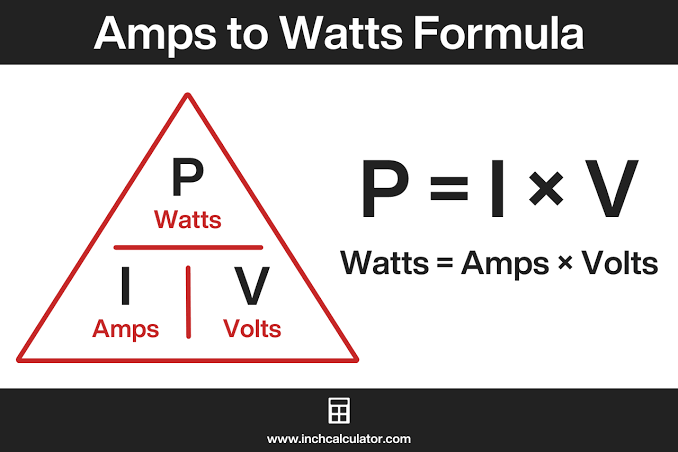
The basic formula for calculating electrical power is:
Watts = Volts × Amps
It is commonly written as:
P = V × I
Where:
- P = electrical power in watts (W)
- V = voltage in volts (V)
- I = current in amperes (A)
For a 120-volt circuit, the formula becomes:
Watts = 120 × Amps
For example, if an appliance draws 8 amps:
120 × 8 = 960 watts.
Therefore, the appliance uses approximately 960 watts of real electrical power if the simple formula applies. For direct current (DC) and purely resistive AC loads, this calculation is straightforward; other AC loads may require a power-factor adjustment.
How to Calculate 120V to Watts in Three Steps
You can calculate power manually with three simple steps.
Step 1: Find the voltage. Confirm that the device or supply is rated for 120 volts.
Step 2: Check the current. Look at the appliance nameplate, manufacturer specifications, or equipment documentation for its amp rating.
Step 3: Multiply volts by amps. Multiply 120 by the current value to calculate watts when the basic power formula applies.
For instance, a 120V appliance rated at 4.5 amps has a calculated power of 540 watts.
If the equipment label lists watts directly, use that manufacturer-provided rating instead of estimating power from voltage alone.
120V to Watts Conversion Chart
The following chart shows how calculated power changes as current increases at a constant voltage of 120 volts.
| Current (Amps) | Voltage (Volts) | Calculated Power (Watts) |
|---|---|---|
| 0.5 A | 120 V | 60 W |
| 1 A | 120 V | 120 W |
| 2 A | 120 V | 240 W |
| 3 A | 120 V | 360 W |
| 4 A | 120 V | 480 W |
| 5 A | 120 V | 600 W |
| 6 A | 120 V | 720 W |
| 7 A | 120 V | 840 W |
| 8 A | 120 V | 960 W |
| 9 A | 120 V | 1,080 W |
| 10 A | 120 V | 1,200 W |
| 12 A | 120 V | 1,440 W |
| 13 A | 120 V | 1,560 W |
| 15 A | 120 V | 1,800 W |
| 20 A | 120 V | 2,400 W |
| 25 A | 120 V | 3,000 W |
| 30 A | 120 V | 3,600 W |
These values represent mathematical power calculations, not permission to draw that much current from any particular outlet, plug, wire, or circuit breaker. The safe operating limit depends on the entire electrical installation, equipment ratings, applicable electrical codes, and the type and duration of the load.
How Many Watts Is 120V at Different Amp Ratings?
The most useful way to answer a 120-volt wattage question is to identify the current rating first. Here are several common calculations and what they mean in practice.
120V to Watts at 1 Amp
Calculation: 120 × 1 = 120 watts.
A device drawing 1 amp at 120 volts has a calculated power of 120 watts when the basic formula applies. Small electrical devices can draw relatively little current, although their actual power consumption varies by model and operating mode.
120V to Watts at 5 Amps
Calculation: 120 × 5 = 600 watts.
A 600-watt load might represent a small appliance or several lower-power devices operating together. Always check their actual ratings rather than assuming every device in a category uses the same amount of power.
120V to Watts at 10 Amps
Calculation: 120 × 10 = 1,200 watts.
A 10-amp load at 120 volts corresponds to 1,200 watts under the basic calculation. This is useful when estimating a device’s electrical demand or checking whether several appliances could exceed a circuit’s capacity.
120V to Watts at 15 Amps
Calculation: 120 × 15 = 1,800 watts.
This is a frequently used example for a 120V, 15A circuit. However, 1,800 watts is the mathematical product of the two ratings, not a universal recommendation for continuous use.
For example, in installations governed by US electrical rules, certain continuous loads require additional capacity under applicable code provisions. The familiar 80% calculation gives 12 amps, or 1,440 watts at 120 volts, for a 15-amp circuit when that rule applies. Actual requirements depend on the circuit, equipment, and applicable code.
120V to Watts at 20 Amps
Calculation: 120 × 20 = 2,400 watts.
A 20-amp, 120V circuit has a theoretical power product of 2,400 watts. That figure does not mean that every ordinary household receptacle or extension cord can safely support a 20-amp load.
Check the breaker, receptacle, conductors, cord rating, and equipment instructions before connecting high-power appliances.
Can You Convert 120 Volts to Watts Without Knowing Amps?
No, not uniquely. Voltage and power are different quantities, and knowing only the voltage does not establish how much current a device draws.
Imagine two appliances connected to the same 120V supply. One draws 0.5 amps, while the other draws 8 amps. Using the basic formula, their calculated power levels are 60 watts and 960 watts, respectively.
You can calculate power if you know another suitable value, such as current and power factor for an AC load, or resistance for an appropriate resistive circuit.
Calculate Watts When Resistance Is Known
For a suitable resistive load, you can use this formula:
Watts = Volts² ÷ Resistance
Written mathematically:
P = V² / R
Suppose a resistive heating element has a resistance of 24 ohms and operates at 120 volts.
- Voltage = 120V
- Resistance = 24Ω
- Calculation = 120² ÷ 24
- Result = 600 watts
This method is useful when resistance is known and remains appropriate for the operating conditions. It should not be applied blindly to complex electronic devices or motors, whose electrical behavior may be more complicated.
Understanding 120V AC Power and Power Factor
Most household electrical systems that use 120 volts operate on alternating current (AC). In AC systems, voltage and current vary over time, so the relationship between their values can be more complicated than a simple multiplication.
For a purely resistive load, such as a conventional resistive heater, multiplying RMS voltage by current gives real power in watts. For many motors, compressors, and electronic power supplies, however, the current waveform and voltage waveform may not align perfectly.
For a single-phase AC circuit, the general real-power formula is:
Watts = Volts × Amps × Power Factor
Or:
P = V × I × PF
Power factor (PF) describes how effectively apparent electrical power is converted into real power. It generally ranges from 0 to 1 for ordinary loads operating in the usual manner.
Example: 120V AC at 10 Amps With a 0.8 Power Factor
Suppose an AC device operates at 120 volts, draws 10 amps, and has a power factor of 0.8.
Calculation:
120 × 10 × 0.8 = 960 watts
The apparent power is 1,200 volt-amperes (VA), while the real power is 960 watts.
This distinction matters when sizing generators, inverters, UPS systems, and other equipment that must handle both real power and apparent power. For nonlinear electronic loads, determining true power factor may also require accounting for waveform distortion.
120 Volts to Watts: Watts, Kilowatts, and Electricity Usage
Watts measure the rate of electrical power consumption. Kilowatts (kW) are simply larger units of power, with 1 kilowatt equal to 1,000 watts.
Here are some common conversions:
| Watts | Kilowatts |
|---|---|
| 60 W | 0.06 kW |
| 120 W | 0.12 kW |
| 600 W | 0.6 kW |
| 1,000 W | 1 kW |
| 1,200 W | 1.2 kW |
| 1,440 W | 1.44 kW |
| 1,800 W | 1.8 kW |
| 2,400 W | 2.4 kW |
Knowing the wattage helps you estimate electricity consumption, but you must also know how long the device operates.
How to Calculate Energy Consumption in kWh
Electricity bills generally measure energy in kilowatt-hours (kWh), not simply watts.
Use this formula:
Energy (kWh) = Power (kW) × Time (hours)
For example, a 600-watt appliance operating for 5 hours consumes:
- Convert 600 watts to kilowatts: 600 ÷ 1,000 = 0.6 kW.
- Multiply by operating time: 0.6 × 5 = 3 kWh.
- Multiply the energy used by your electricity tariff to estimate the cost.
If electricity costs $0.20 per kWh, the estimated cost for this example is $0.60. Your actual bill may include additional charges, and the estimate assumes the appliance continuously draws its stated power.
Practical Applications of 120V to Watts Calculations
The conversion is useful in several everyday situations. Understanding the limits of the calculation is just as important as knowing the formula.
Choosing a Generator
Generator specifications often list both rated watts and maximum or starting watts. Some appliances, particularly refrigerators, air conditioners, and electric motors, require additional power when starting.
Calculate the running demand of each appliance, then check its starting requirements. The generator must meet the applicable continuous-power and starting-power demands without exceeding its ratings.
Selecting an Inverter
An inverter converts DC power into AC power. When selecting one, compare the total running wattage of connected devices with the inverter’s continuous output rating and surge capability.
You should also account for conversion losses and the capacity of the battery supplying the inverter. A device that needs 1,200 watts of AC output can require more than 1,200 watts from the battery because the conversion is not perfectly efficient.
Checking Appliance Compatibility
An appliance’s voltage, current, and power ratings help establish whether it is suitable for a particular supply. Read the product label and manual, especially when using equipment purchased for a different country’s electrical system.
A voltage rating of 120V does not automatically mean that the device is compatible with a 220–240V supply. Do not connect equipment to an incompatible voltage simply because its plug can be adapted.
Estimating Extension Cord and Circuit Demand
A wattage calculation can help estimate the current required by a load. For example, a 1,200-watt resistive appliance operating at 120 volts draws approximately 10 amps.
That estimate alone cannot establish whether an extension cord, receptacle, or circuit is safe. Wire size, cord length, insulation, connection quality, ambient conditions, and applicable electrical standards all matter.
Common Mistakes When Converting 120V to Watts
A few misunderstandings can produce inaccurate calculations or unsafe decisions.
1. Assuming voltage determines wattage. Voltage alone does not tell you the power consumption. You also need current or another suitable electrical measurement.
2. Confusing watts with watt-hours. Watts describe power, whereas watt-hours describe energy used over time. A 500-watt device running for two hours consumes 1,000 watt-hours, equivalent to 1 kWh.
3. Ignoring power factor. For certain AC loads, volts multiplied by amps gives apparent power in VA rather than the actual real power in watts. Include power factor when appropriate.
4. Treating the calculated maximum as a safe operating limit. The mathematical product of voltage and current does not account for all circuit, wiring, temperature, or continuous-load requirements.
5. Assuming every appliance draws its rated current constantly. Many devices change their consumption according to operating mode, thermostat settings, motor load, charging stage, or other conditions.
6. Ignoring startup current. Motors and compressors may briefly draw more current when starting than they draw during normal operation. This matters when selecting generators, inverters, and protective equipment.
Electrical Safety When Working With 120V Equipment
A 120V supply can cause serious electric shock, burns, and potentially fatal injuries. Treat household mains electricity with care even when the voltage appears familiar.
Follow these basic precautions:
- Read the appliance nameplate and manufacturer’s instructions.
- Never exceed the rated capacity of a circuit, cord, plug, or power strip.
- Stop using damaged, frayed, overheated, or loose electrical equipment.
- Keep electrical connections away from water and damp conditions unless the equipment is specifically designed and rated for those conditions.
- Do not bypass circuit breakers, fuses, grounding, or other protective devices.
- Consult a qualified electrician for circuit changes, damaged wiring, or uncertain installation requirements.
If a breaker repeatedly trips, a plug becomes unusually hot, or you notice a burning smell, stop using the affected equipment and have the problem investigated. Increasing the breaker rating without verifying the wiring and circuit design can create a fire hazard.
Frequently Asked Questions About 120V to Watts
1. How many watts is 120 volts?
There is no fixed wattage for 120 volts alone. Power depends on current and, for certain AC loads, power factor. At 120 volts and 1 amp, the basic calculation gives 120 watts; at 10 amps, it gives 1,200 watts for a load with a power factor of 1.
2. How many watts is 120V at 15 amps?
Multiply 120 volts by 15 amps to obtain 1,800 watts under the basic power calculation. For a practical installation, the permitted load may be lower depending on the circuit rating, continuous-use requirements, and applicable electrical code.
3. How many watts is 120V at 20 amps?
At 120 volts and 20 amps, the calculated power is 2,400 watts when the basic formula applies. This is a mathematical result, not confirmation that a particular outlet, extension cord, or appliance can safely handle the load.
4. Can I calculate watts from volts without knowing amps?
Not uniquely. You need current, resistance for a suitable resistive circuit, or other sufficient electrical information. If the equipment label lists its wattage, use that rating; if it lists voltage and current, calculate power using the appropriate formula.
5. How do I convert 120V watts into electricity costs?
First, determine the appliance’s actual power consumption in watts. Divide watts by 1,000 to obtain kilowatts, multiply by the number of operating hours to calculate kWh, and then multiply the result by your electricity price per kWh.
For example, a 1,200-watt appliance operating for 2 hours uses 2.4 kWh if it continuously consumes 1,200 watts. At $0.20 per kWh, the energy cost would be $0.48 before any additional fees.
Conclusion: Calculate 120V to Watts Correctly
Converting 120V to watts is straightforward once you know the current and understand which power formula applies. For a basic DC circuit or a purely resistive load, multiply volts by amps; for a single-phase AC load where power factor matters, multiply volts, amps, and power factor to estimate real power.
Use the conversion chart to estimate wattage, check equipment labels for actual ratings, and calculate kilowatt-hours when estimating electricity costs. Before connecting multiple appliances or selecting a generator, inverter, or extension cord, verify that every component is rated for the intended load.
Your next step: Find the amp rating on your device’s label and multiply it by 120 to calculate the basic wattage. If the device uses AC power and its power factor is relevant, account for that as well, and confirm the installation’s safe operating limits before use.
Suggested Sources for Further Reading
- Open University — Relationships Between Electrical Quantities
- Oracle Documentation — Electrical Conversions: Volts, Watts, and Amperes
- University of Illinois Division of Research Safety — Electrical Safety in the Research Laboratory
Disclaimer: This article provides general educational information about electrical calculations. It is not a substitute for manufacturer instructions, applicable electrical codes, or advice from a qualified electrician.
