


The traditional model of economic growth is broken. For decades, rapid industrial booms followed a predictable, painful script: a major factory or mine opens, thousands of workers flood the area, housing prices skyrocket, public infrastructure buckles, and the local ecosystem pays the ultimate price.
But what if a municipality could compress 20 years of massive economic growth into a single five-year window, without breaking its communities or abandoning its climate goals?
Enter Bodenxt, an ambitious, systems-based development framework engineered by the municipality of Boden in northern Sweden. As Europe races to build a low-carbon economy, this initiative stands as a living laboratory for the green transition. By intertwining multi-billion-dollar clean industries with localized infrastructure, clean energy grids, and human-centric city design, the project proves that rapid industrialization can be both smart and genuinely sustainable.
Why Bodenxt is Overhauling the Traditional Industrial Model
Historically, industrial expansion operated in isolated silos. Companies built manufacturing plants while local governments scrambled to build roads, developers built housing years late, and schools struggled to accommodate sudden population spikes.
The Bodenxt platform eliminates this fragmentation by utilizing a unified, systems-first approach. Instead of treating municipal elements as independent variables, it links economic growth directly to real-time public resource planning.
┌────────────────────────────────────────────────────────┐
│               Bodenxt Systems Integration              │
└───────────────────────────┬────────────────────────────┘
                            │
         ┌──────────────────┼──────────────────┐
         ▼                  ▼                  ▼
┌─────────────────┐┌─────────────────┐┌─────────────────┐
│ Green Industry  ││  Smart Grid &   ││  Social Core &  │
│  (Stegra H2)    ││  Circular Heat  ││   Housing Tech  │
└─────────────────┘└─────────────────┘└─────────────────┘
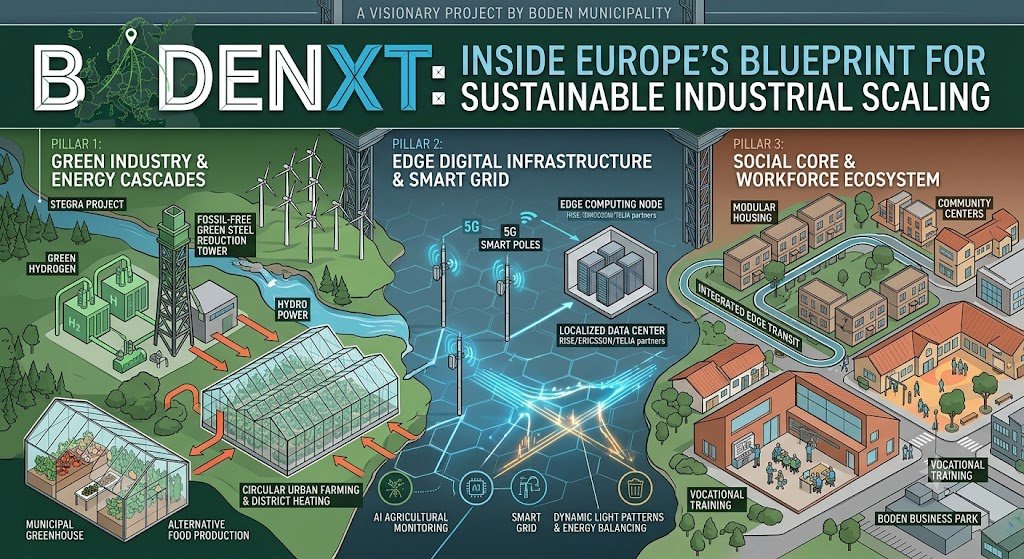
This model treats the entire municipality as an integrated ecosystem. When a massive anchor project—such as the Stegra green steel initiative—announces scaling plans, the platform automatically triggers synchronized pipelines across housing development, professional training initiatives, public transport loops, and local grid upgrades. The goal is simple: ensure that no single sector of the local economy falls behind or becomes a bottleneck.
The Core Pillars Driving the Green Transformation
The success of the platform rests on a distinct multi-tiered strategy designed to balance massive industrial output with high community livability.
1. Fossil-Free Industrial Foundations
At the heart of the initiative is a commitment to decoupling heavy manufacturing from fossil fuels. The region relies heavily on the Stegra project, which features one of the world’s largest green hydrogen production facilities. By utilizing abundant local hydro and wind energy, the region replaces traditional coal-fired blast furnaces with clean hydrogen direct reduction processes, drastically lowering the global warming potential of structural steel production.
2. High-Density Circular Resource Design
True sustainability goes beyond clean power source selection; it requires strict circular resource loops. The project leverages industrial byproducts to power local systems:
-
Surplus Heat Utilization: Massive amounts of thermal energy generated by nearby data centers and green hydrogen plants are funneled directly into massive, year-round municipal greenhouses.
-
Agricultural Integration: This redirected heat fuels alternative indoor food production systems, significantly reducing northern Sweden’s historical reliance on carbon-heavy food imports.
-
Waste-to-Resource Pipelines: Water filtration systems and solid waste management loops are digitized, allowing the municipality to reuse resources internally before discharging anything into the environment.
3. Edge Computing and Next-Gen Digital Infrastructure
A physical transformation requires a robust digital backbone. Through collaborations with the Research Institutes of Sweden (RISE), Ericsson, and Telia, the city has integrated advanced 5G Edge computing into its public infrastructure.
Processing data near its physical source, rather than routing it to distant data centers, eliminates latency. This rapid data handling enables real-time traffic optimization, automated municipal waste collection, dynamic energy grid balancing, and AI-driven agricultural monitoring systems.
Navigating the Human Component: Workforce and Housing Realities
An economy cannot transition if its workforce has nowhere to live and no pathways to develop new capabilities. The framework actively addresses the human element of rapid regional expansion through target programs.
    Traditional Boomtown                  Bodenxt Model
┌───────────────────────────┐       ┌───────────────────────────┐
│ ∙ Unplanned housing hikes │       │ ∙ Modular housing blocks  │
│ ∙ Out-of-region commuters │  VS   │ ∙ Localized talent shifts │
│ ∙ Strained infrastructure │       │ ∙ Integrated edge transit │
└───────────────────────────┘       └───────────────────────────┘
To combat the severe accommodation shortages that plague growing regions, the platform leverages advanced modular construction techniques. Large residential complexes—such as the recent 660-room community living quarters and new 50-apartment complexes—are deployed quickly to provide high-quality housing for incoming talent and structural engineers.
Concurrently, the municipality has overhauled its educational ecosystem through its local Lärcentrum (Learning Center) and Boden Business Park. By matching vocational training tracks with the immediate workforce requirements of green technology employers, the program helps local workers adapt to technical roles in clean energy management and automation.
How Bodenxt Serves as a Global Model for Municipal Scaling
Urban planners and corporate leaders globally face a critical challenge: how to build sustainable industrial capacity quickly without causing local infrastructure to collapse under the strain.
The Bodenxt template provides three valuable, actionable insights for regional development:
-
Lead with Spatial Strategy: Do not issue permits for industrial installations without first mapping out corresponding housing, education, and transport expansions.
-
Productize Energy Cascades: Treat industrial waste heat not as a problem to be mitigated, but as a critical municipal asset for urban farming and district heating networks.
-
Deploy Smart Technologies Early: Use real-time 5G Edge infrastructure to manage the stress that rapid population growth places on utility networks.
The Road Ahead: Overcoming Scalability Bottlenecks
While the initiative has proven remarkably successful, long-term sustainability requires continuous improvement. Balancing international recruitment with the preservation of regional culture demands careful management. Furthermore, maintaining clean power availability as heavy industries scale requires significant ongoing investments in localized distribution grids.
However, by addressing these challenges through an open, integrated platform rather than isolated corporate projects, the municipality remains highly resilient. The strategy demonstrates that with clear, systemic planning, communities can successfully navigate rapid economic growth while actively reducing their carbon footprint.
Frequently Asked Questions
What exactly is Bodenxt?
It is a comprehensive development platform created by the municipality of Boden in northern Sweden. It coordinates rapid social, economic, and infrastructure growth driven by major green industrial investments in the region.
How does the platform support the green transition?
The platform integrates clean energy production—such as large-scale green hydrogen and fossil-free steel—with circular municipal programs. This includes using industrial waste heat to warm local agricultural greenhouses and power district heating systems.
What role does technology play in this initiative?
The framework leverages 5G Edge computing and AI technology developed alongside research institutions like RISE. This digital infrastructure manages public transport loops, optimizes waste collection, and ensures efficient electrical grid management.
How is the project addressing local housing shortages?
The municipality utilizes fast-tracked, sustainable modular housing developments. These projects quickly provide hundreds of modern apartments and co-living spaces for incoming technical talent and their families.
Can other global cities replicate this framework?
Yes. The model provides a clear blueprint for integrating industrial expansion with urban planning, circular asset management, and proactive talent education.
