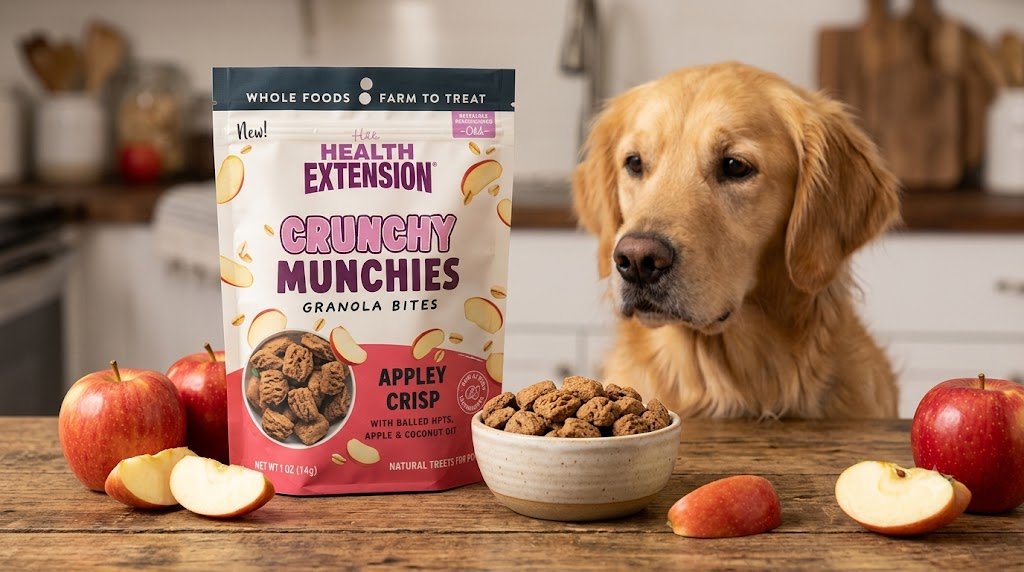

Health Extension Crunchy Munchies Appley Crisp Dog Treats are crunchy, apple-inspired dog biscuits made primarily from oat flour, rolled oats, cane molasses, coconut oil and apple puree. The current product is sold as Crunchy Munchies Granola Bites–Appley Crisp in a 5-ounce bag, with each treat providing approximately 12 calories. Although the recipe has a relatively short ingredient list, it is not suitable for every dog, particularly those that must avoid oats, added sugar, higher-fat treats or firm textures.
This article examines the complete ingredient list, guaranteed analysis, calorie content, portion control, possible advantages, practical limitations and the types of dogs for which these treats may or may not be appropriate. Because recipes and packaging can change, owners should compare this information with the label on the bag they purchase.
Pet health disclaimer: This article provides general product and feeding information, not veterinary advice. Dogs with allergies, pancreatitis, diabetes, obesity, dental disease or prescription-diet requirements should be assessed by a veterinarian before receiving a new treat.
What Are Health Extension Crunchy Munchies Appley Crisp Dog Treats?
Health Extension’s Appley Crisp treats are baked, crunchy dog snacks designed to resemble small granola bites. Their flavour profile comes from apple puree, cinnamon and vanilla rather than meat, cheese or artificial meat flavouring. The manufacturer describes them as limited-ingredient treats made with natural, USA-sourced ingredients and without artificial additives.
The present packaging identifies the product as “Crunchy Munchies Granola Bites” and highlights rolled oats, apple and coconut oil on the front. Retail listings may use slightly different names, including “Appley Crisp Dog Treats,” “Apple Crisp,” or “Crunchy Munchies Appley Crisp,” but these generally refer to the same 5-ounce recipe.
These are supplemental treats, not complete dog food. They do not contain the full balance of protein, essential fatty acids, vitamins and minerals required to replace a nutritionally complete daily diet. Treats and snacks are legally considered pet food, but a treat does not automatically meet the standards for a complete and balanced meal.
Product Facts at a Glance
| Product detail | Current published information | Practical meaning |
|---|---|---|
| Product type | Baked crunchy dog treat | Best used as an occasional reward |
| Package size | 5 ounces or 142 grams | A relatively small resealable treat bag |
| Main ingredients | Oat flour and rolled oats | This is an oat-based, grain-containing recipe |
| Fruit ingredient | Apple puree | Apple is included, but not as the first ingredient |
| Calories | 12 kcal per treat | Portions matter, especially for small dogs |
| Protein | Minimum 8% | Not a high-protein training treat |
| Fat | Minimum 14% | May not suit every fat-restricted diet |
| Fibre | Maximum 2% | Should not be treated as a high-fibre supplement |
| Moisture | Maximum 6% | Low moisture contributes to the crunchy texture |
| Intended role | Reward or occasional snack | It should not replace regular meals |
The package size, ingredients, calorie statement and guaranteed analysis above come from Health Extension’s current product information.
Complete Ingredient List
The manufacturer currently lists the ingredients in this order:
Oat flour, rolled oats, cane molasses, coconut oil, apple puree, cinnamon and vanilla.
Ingredient order is useful because pet-food ingredients are generally listed by weight before processing. Oat flour and rolled oats therefore make up more of the recipe than apple puree. Buyers should think of this primarily as an oat biscuit with apple flavour, not as a dehydrated apple treat.
Oat Flour and Rolled Oats
Oats provide the structural base that allows the biscuits to be baked and remain crisp. They also make the product unsuitable for a dog undergoing a strict grain-elimination trial.
Oats are grains. This matters because the product has sometimes appeared within grain-free retail or website collections, while its published formula clearly contains both oat flour and rolled oats. Owners seeking a genuinely grain-free treat should rely on the ingredient panel rather than a category page, search filter or isolated promotional label.
A dog that tolerates oats may eat them without difficulty. A dog with a confirmed oat sensitivity, however, should avoid the product. Owners conducting a veterinary-directed elimination diet should not add any oat-based biscuit unless the veterinarian has approved it.
Cane Molasses
Cane molasses contributes sweetness, flavour, colour and moisture control. It is an added sweetening ingredient, even though the recipe is marketed as natural and free of artificial additives.
The presence of molasses does not automatically make a treat unsafe. The relevant question is how much of the dog’s total calorie intake comes from treats and whether the dog has a condition requiring tighter control of calories or carbohydrates.
Dogs with diabetes, obesity or a medically managed diet should not be given sweetened treats casually. The veterinarian may recommend a different reward or allow only a carefully measured portion.
Coconut Oil
Coconut oil supplies fat and helps influence texture and flavour. It also contributes to the product’s minimum crude-fat level of 14%.
Coconut oil is sometimes promoted online as if it gives every dog major skin, coat, digestive or immune benefits. A small amount used in a baked biscuit should not be expected to produce therapeutic effects. In this product, it is more reasonably viewed as a recipe ingredient and calorie source than as a treatment for a health condition.
Dogs with pancreatitis, hyperlipidaemia or a prescribed low-fat diet may need to avoid treats with this fat level. A guaranteed analysis cannot reveal every aspect of fat digestibility, so individual veterinary advice remains important.
Apple Puree
Apple puree provides the product’s distinguishing flavour. Apples can be included safely in many canine foods, but the presence of apple does not turn the biscuit into a meaningful fruit serving.
Apple puree is the fifth ingredient, after two oat ingredients, molasses and coconut oil. The product page does not state how much apple puree is present, so claims that each biscuit supplies a substantial amount of apple fibre, vitamins or antioxidants would be unsupported.
This distinction is easy to miss. “Made with apple” confirms that apple is present; it does not reveal the percentage of the final treat or establish a specific health benefit.
Cinnamon and Vanilla
Cinnamon and vanilla provide the apple-crisp aroma and flavour profile. They appear near the end of the ingredient list, suggesting that relatively small amounts are used.
Owners should never assume that a homemade human apple crisp is equally suitable for dogs. Human desserts may contain far more sugar and fat and could include raisins, nutmeg, chocolate, alcohol-based flavourings or the sweetener xylitol. WSAVA identifies raisins, chocolate and xylitol among foods that can be toxic to dogs.
Guaranteed Analysis and Calories Explained
Health Extension publishes the following guaranteed analysis for Appley Crisp:
| Nutrient | Guaranteed amount |
|---|---|
| Crude protein | Minimum 8% |
| Crude fat | Minimum 14% |
| Crude fibre | Maximum 2% |
| Moisture | Maximum 6% |
| Calorie content | 2,100 kcal/kg |
| Calories per treat | Approximately 12 kcal |
These figures describe minimum or maximum nutrient levels in the product as sold. They should not be interpreted as a complete nutritional profile. For example, the 8% protein figure does not describe protein quality, amino-acid balance or the percentage of a dog’s daily protein requirement supplied by one biscuit.
The calorie figure is usually more useful when deciding how many treats to offer. At 12 calories each, the biscuits are not extremely high in calories, but they are also not tiny one- or two-calorie training rewards.
Why 12 Calories Can Be Significant for a Small Dog
The World Small Animal Veterinary Association recommends keeping treats below 10% of a dog’s daily calorie intake. Its current owner guidance estimates a treat allowance of about 14 calories for an average healthy adult dog weighing 2 kilograms and about 24 calories for a 4-kilogram dog, although individual energy needs vary.
That creates an easily overlooked portion issue:
- One whole Appley Crisp treat supplies almost the entire suggested treat allowance for a typical 2-kilogram dog.
- Two treats provide about 24 calories, potentially using the full suggested allowance for a typical 4-kilogram dog.
- Other snacks, dental chews, table foods and food used for medication must be counted in the same treat budget.
For a small dog, breaking one biscuit into several pieces may be more appropriate than offering multiple whole treats. For a larger dog, the calorie impact of one biscuit is smaller, but unrestricted handfuls can still contribute to weight gain.
How Appley Crisp Compares With Other Crunchy Munchies Flavours
Health Extension also offers Blueberry Ruffin and Peanutty Squares versions. All three currently have the same published calorie content and guaranteed analysis. The primary recipe difference is the flavour ingredient used after coconut oil.
| Flavour | Distinguishing ingredient | Calories per treat | Protein and fat | Main reason to choose or avoid |
|---|---|---|---|---|
| Appley Crisp | Apple puree | 12 kcal | 8% protein, 14% fat | Suitable for dogs that enjoy fruit-flavoured oat biscuits |
| Blueberry Ruffin | Blueberries | 12 kcal | 8% protein, 14% fat | Similar nutrition with a blueberry flavour |
| Peanutty Squares | Peanut butter | 12 kcal | 8% protein, 14% fat | May appeal to peanut-butter-loving dogs but is inappropriate for a peanut-sensitive dog or household |
Switching from Appley Crisp to Blueberry Ruffin does not meaningfully reduce calories or fat according to the published figures. The decision is therefore mainly about flavour preference and ingredient tolerance rather than a major nutritional difference.
Potential Advantages
A Short, Recognisable Ingredient List
The recipe contains seven listed ingredients. This makes it easier to review than a treat containing numerous proteins, flavour systems, colours and preservatives.
A short ingredient list can be useful when an owner is trying to avoid a particular ingredient. It does not guarantee that the product is hypoallergenic, and it does not reveal possible cross-contact with ingredients processed in the same facility.
No Meat Protein Listed
No meat, poultry, fish, egg or dairy ingredient appears in the current Appley Crisp formula. This may make the treat useful for some dogs whose regular food already supplies plenty of animal protein or whose owners want a non-meat reward.
It should not automatically be called vegan, however. The manufacturer’s public product information does not establish vegan certification or rule out cross-contact with animal-derived ingredients during manufacturing.
Clearly Published Calorie Information
The manufacturer provides both calories per kilogram and calories per treat. This is valuable because calorie information allows owners to include the biscuits in a measured feeding plan instead of guessing.
WSAVA advises owners to contact a manufacturer when commercial treat calories are not stated. That extra step is unnecessary here because Health Extension publishes approximately 12 calories per piece.
Crunchy Texture
Some dogs strongly prefer crisp biscuits to soft treats. The firm texture can also make the product less greasy to handle and convenient for occasional rewards at home.
A crunchy biscuit should not be confused with a clinically proven dental product. Health Extension does not present Appley Crisp as a Veterinary Oral Health Council-accepted dental chew, and ordinary crunchiness does not guarantee meaningful plaque or tartar control.
Limitations and Possible Concerns
It Contains Added Sweetener
Cane molasses is the third listed ingredient. Owners specifically seeking an unsweetened treat may prefer a product made without molasses, syrup, honey or other added sweetening ingredients.
The practical concern is less about a single ingredient in isolation and more about frequency, total calories and the dog’s health. A healthy active dog receiving a small measured portion is different from an overweight dog receiving multiple biscuits plus other daily snacks.
It Is Not Grain-Free
Oat flour and rolled oats are the first two ingredients. Regardless of how the product may be categorized by a retailer or search filter, it contains grain.
This is not inherently a disadvantage. Most dogs do not need grain-free treats. It becomes important when a dog has a documented dietary restriction or is completing a controlled food trial.
It Is Not a High-Value Meat Treat
Some dogs are highly motivated by crunchy apple biscuits, while others respond better to aromatic meat treats. Appley Crisp may work well for casual rewards but may not be sufficiently motivating during difficult recall training, behaviour modification or distracting outdoor situations.
Its texture also makes rapid reinforcement less convenient. The dog must stop and chew, whereas a tiny soft training treat can be swallowed quickly so training can continue.
The Fat Level Deserves Attention
The formula contains at least 14% crude fat as fed. That figure does not make the treat universally “high fat,” but it may be unsuitable for dogs whose veterinarian has prescribed strict fat restriction.
Dogs with a history of pancreatitis should not be given a new treat simply because the front label uses terms such as natural or wholesome. The entire diet and the individual dog’s medical history matter more than front-of-package language.
Firm Biscuits May Not Suit Every Mouth
Puppies with developing teeth, senior dogs, dogs with missing teeth and animals with painful dental disease may struggle with firm treats. Breaking a biscuit into smaller pieces may help some dogs, but it does not solve pain or chewing difficulty caused by oral disease.
Dogs should be supervised while eating. WSAVA advises selecting an appropriate treat size and shape to reduce choking risk.
Details Buyers Commonly Miss
“Human-Grade Ingredients” Has a Specific Meaning
Health Extension describes these treats as being made with human-grade ingredients. AAFCO explains that a valid human-grade claim concerns more than ingredients that sound familiar. Every ingredient and the finished product must be stored, handled, processed and transported in compliance with applicable human-food requirements, and a claim about “human-grade ingredients” is acceptable only when the product as a whole qualifies.
Even when properly substantiated, “human grade” does not mean nutritionally superior for every dog. It describes sourcing and processing standards, not whether the calorie level, fat content or ingredient combination is appropriate for a particular animal.
The treats also remain dog food. Owners should not treat an animal-food label as permission for regular human consumption.
“Natural” Does Not Mean Sugar-Free or Low-Calorie
The recipe uses recognisable ingredients and does not list artificial colours or preservatives, but it still contains cane molasses and supplies 12 calories per treat. Natural ingredients can contribute substantial calories.
A more useful buying question is not simply “Is this natural?” but “Does the ingredient list and calorie content fit my dog’s needs?”
Apple Is Not the Main Ingredient
The product name and package imagery emphasize apple, yet apple puree is the fifth ingredient. Oat flour, rolled oats, cane molasses and coconut oil appear before it.
This does not make the label inaccurate. It does mean buyers should expect a baked oat biscuit with an apple-crisp flavour rather than a treat composed mainly of fruit.
The Three Flavours Are Nutritionally Very Similar
Appley Crisp, Blueberry Ruffin and Peanutty Squares have the same stated calorie density and guaranteed analysis. Choosing the blueberry version instead of apple does not reduce the stated fat or calories.
The flavour varieties are therefore better understood as taste options, not significantly different nutritional formulas.
The Number of Treats in a Bag May Vary
The company provides calories per treat and net package weight but does not publish a guaranteed piece count on the current product page. Because baked pieces can vary in size and weight, the number of biscuits in individual bags may differ.
For precise calorie control, use the manufacturer’s per-treat estimate while also checking for unusually large or broken pieces.
Who May Find These Treats Suitable?
Health Extension Crunchy Munchies Appley Crisp Dog Treats may be a reasonable option for:
- Healthy dogs that tolerate oats and coconut oil
- Dogs that prefer crunchy biscuits
- Owners seeking a meat-free ingredient list
- Occasional at-home rewards
- Larger dogs for which a 12-calorie reward fits comfortably within the daily calorie budget
- Dogs that enjoy apple, cinnamon or baked-oat aromas
Suitability still depends on portion size, chewing ability and the rest of the diet.
Who Should Consider a Different Treat?
Another product may be more appropriate for:
- Dogs with a confirmed oat or grain sensitivity
- Dogs on a veterinary elimination diet
- Dogs requiring very low-calorie training rewards
- Dogs with pancreatitis or prescribed fat restriction
- Dogs with diabetes or tightly controlled carbohydrate intake
- Overweight dogs already receiving several other treats
- Puppies, seniors or dental patients unable to chew firm biscuits safely
- Dogs that need a highly motivating meat-based reward
For frequent training, a treat containing one to three calories per piece may be easier to use without exhausting the daily treat allowance. Another option is to reserve part of the dog’s measured regular food and use individual pieces as rewards.
How to Feed Appley Crisp Treats Responsibly
Calculate the Treat Budget
Start with the dog’s estimated daily calorie requirement. Keep all extras—commercial treats, dental chews, table food, supplements with calories and food used to hide medication—below roughly 10% of that total unless a veterinarian has recommended another plan.
Because Appley Crisp contains 12 calories per treat, divide the available treat calories by 12 to estimate the maximum number of whole pieces. For a small dog, the appropriate answer may be less than one whole biscuit.
Break Treats Into Smaller Rewards
A dog does not necessarily need a complete biscuit to experience reinforcement. Breaking one piece into two or four portions can make it last through several simple behaviours.
The pieces should remain large enough to handle but small enough for the dog to swallow safely. Always supervise the first feeding to see how the dog chews them.
Introduce Gradually
Offer a small portion initially, particularly if the dog has not previously eaten oats, coconut oil or molasses. Watch for vomiting, diarrhoea, excessive gas, itching, facial swelling or other unusual changes.
Mild digestive upset does not prove an allergy, but repeated symptoms after the same product justify stopping it and consulting a veterinarian. Facial swelling, breathing difficulty, collapse or repeated vomiting requires urgent veterinary attention.
Store the Bag Properly
Keep the package sealed in a cool, dry area away from sunlight, heat, moisture and pests. Low-moisture baked biscuits can lose their crispness when exposed to humid air.
Do not feed treats that smell rancid, appear mouldy, have become unusually damp or show signs of insect contamination. Retain the packaging until the bag is finished because the lot number and best-before date may be needed if a quality problem occurs.
Recall and Product-Change Considerations
A search of current FDA and AVMA recall resources did not identify a published recall specifically naming Health Extension Crunchy Munchies Appley Crisp Dog Treats at the time this article was researched. Absence from a search is not a permanent guarantee, and recall status can change after publication. The FDA and AVMA maintain ongoing recall and safety-alert resources for pet products.
Owners should check current notices if a bag has an unusual smell, visible contamination or a sudden cluster of illnesses associated with feeding. Stop using a suspected product, preserve the bag and lot information, and contact the manufacturer and veterinarian.
Ingredient lists can also change without older retailer descriptions disappearing immediately. The physical package in hand is the most relevant source for the specific batch being fed.
Frequently Asked Questions
Are Health Extension Appley Crisp treats grain-free?
No. The current recipe lists oat flour and rolled oats as its first two ingredients, and oats are grains. Owners looking for grain-free dog treats should not rely solely on a website category or search filter. They should examine the ingredient statement printed on the current package.
How many calories are in each Appley Crisp treat?
Health Extension states that each treat contains approximately 12 calories, with an energy density of 2,100 kcal per kilogram. Twelve calories can represent most of a very small dog’s daily treat allowance, so pieces may need to be broken into smaller portions.
Can puppies eat Health Extension Crunchy Munchies?
A healthy puppy that has started solid food and can safely chew firm biscuits may be able to eat a small piece. However, puppies have limited calorie allowances and developing teeth. Choose an age-appropriate portion, supervise chewing and ask a veterinarian before introducing treats to a puppy with digestive or dietary concerns.
Are Appley Crisp treats suitable for dogs with allergies?
That depends on the allergy. The recipe does not list meat, dairy or egg, but it contains oats and coconut oil and may not be manufactured in an allergen-free facility. Dogs completing an elimination diet should receive only foods approved by the supervising veterinarian.
Can these treats help clean a dog’s teeth?
They are crunchy, but they are not presented as an approved dental treatment. An ordinary biscuit should not replace tooth brushing, veterinary dental examinations or a dental product with evidence supporting plaque or tartar control. Dogs with painful or damaged teeth may find the texture difficult.
Are the treats good for weight loss?
They are not specifically formulated as weight-loss treats. Each piece contains about 12 calories, so several can add a meaningful amount to a small dog’s intake. Weight-management plans often work better with smaller low-calorie rewards or portions taken from the dog’s measured daily food.
Do Appley Crisp treats contain artificial preservatives?
The current published ingredient list contains oat flour, rolled oats, cane molasses, coconut oil, apple puree, cinnamon and vanilla, with no artificial preservative listed. Recipes can change, so owners should still check the package ingredient panel before purchase.
Are these treats complete and balanced dog food?
No. They are supplemental snacks intended for rewarding or occasional feeding. They should not replace a nutritionally complete dog food because the product is not formulated to supply every essential nutrient in the proportions required for long-term maintenance.
Conclusion
Health Extension Crunchy Munchies Appley Crisp Dog Treats are oat-based, apple-flavoured biscuits with a concise seven-ingredient recipe and a firm baked texture. Their current formula contains oat flour, rolled oats, cane molasses, coconut oil, apple puree, cinnamon and vanilla, and each piece provides approximately 12 calories.
Their strongest practical features are a transparent ingredient list, published calorie information and a flavour alternative to conventional meat treats. Their main limitations are the presence of grain, added molasses, a minimum 14% crude-fat level and a calorie count that can quickly use a small dog’s treat allowance.
The best decision depends on the individual dog. For a healthy dog that tolerates oats and enjoys crunchy biscuits, a measured portion may be a useful occasional reward. For dogs with dietary restrictions, weight problems, pancreatitis, dental difficulty or prescription-diet needs, Health Extension Crunchy Munchies Appley Crisp Dog Treats should be discussed with a veterinarian or replaced with a more suitable option.