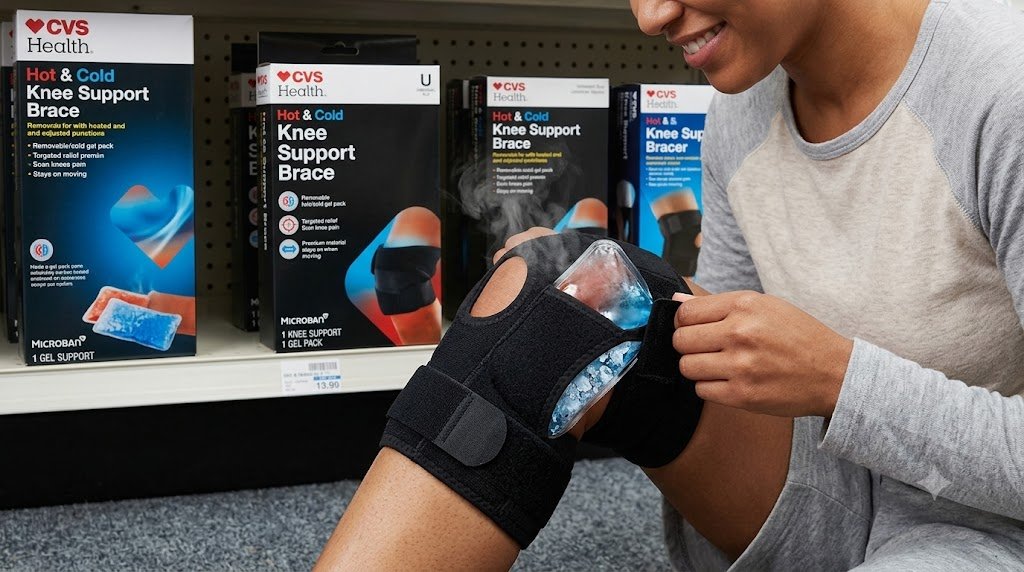

The CVS Health Hot & Cold Knee Support Brace is an adjustable knee wrap that combines light compression with a removable reusable gel pack. The pack can be cooled for swollen or recently irritated knees or heated for stiffness and muscular discomfort. Unlike a hinged orthopedic brace, however, this product is primarily designed for short-term temperature therapy and mild support rather than controlling serious knee instability.
This article explains what comes with the brace, how heat and cold therapy differ, how to apply it safely, who may benefit from it, and when a more supportive knee brace or medical assessment would be appropriate.
Medical disclaimer: This article provides general product and health information. It is not a diagnosis or a substitute for advice from a doctor, physical therapist or other qualified healthcare professional.
What Is the CVS Health Hot & Cold Knee Support Brace?
The CVS Health Hot & Cold Knee Support Brace is a reusable wrap intended to hold a hot or cold gel pack against the knee. Its hook-and-loop fastening system allows users to adjust the compression and apply the product to either the right or left knee.
According to the current CVS listing, the package contains one knee support and one removable gel pack. The adjustable wrap is designed for knee circumferences of up to 20 inches, or approximately 51 centimeters. CVS also describes it as a universal-size, unisex product with antimicrobial technology incorporated into the material.
The product should not be confused with a medical-grade stabilizing brace. It has no rigid hinges, metal stays or immobilizing frame. Its main purposes are to keep a temperature pack in place, provide adjustable compression and offer mild external support while the user rests or carries out light activities.
CVS Health Hot & Cold Knee Support Brace specifications
| Feature | Product information |
|---|---|
| Product type | Hot-and-cold therapy knee wrap |
| Package contents | One adjustable knee support and one reusable gel pack |
| Fit | Either the right or left knee |
| Maximum listed circumference | Up to 20 inches or 51 centimeters |
| Compression | Adjustable through a wraparound fastening system |
| Temperature options | Reusable hot or cold therapy |
| Structural support | Mild; no rigid hinges or immobilizing components |
| Listed product weight | Approximately 0.8 pounds |
| CVS item number | 633903 |
| Eligibility shown by CVS | FSA/HSA eligible |
| Current material description | “Premium material”; complete composition should be checked on the package |
These specifications come from the current CVS product listing and may change if the packaging or design is updated. h0
How the Brace Works
The brace combines two functions that are related but not identical: compression and temperature therapy.
The adjustable wrap applies mild pressure around the knee. This can help keep the gel pack against the treatment area and may make the knee feel more supported. Compression can also be used as part of early self-care for certain minor sprains and soft-tissue injuries, but it must not be tight enough to affect circulation. The American Academy of Orthopaedic Surgeons includes gentle compression alongside rest, ice and elevation in its guidance for many soft-tissue injuries. gel pack provides the heating or cooling effect. Cold reduces tissue temperature and can temporarily numb pain while limiting blood flow to an irritated area. Heat generally has the opposite effect: it increases local circulation and can relax stiff muscles and joints. Because the two therapies have different effects, the best option depends on the type and timing of the symptoms.
The wrap does not cure arthritis, rebuild damaged cartilage, repair a torn ligament or correct a kneecap that repeatedly dislocates. It is a symptom-management product that may make certain types of discomfort easier to manage while the underlying problem heals or receives appropriate treatment.
When to Use Cold Therapy on the Knee
Cold therapy is generally the more suitable option when a knee has recently become swollen, warm or painful after activity or a minor injury. Examples include a mild sprain, an overuse flare, a bump to the knee or swelling after exercise.
MedlinePlus advises using a cloth-covered ice source rather than applying ice directly to the skin. Its knee-pain guidance recommends applications of up to about 15 minutes, while other orthopedic guidance commonly recommends cold packs for up to 20 minutes at a time. d may be useful when:
- The knee is visibly swollen after activity.
- Pain started after a recent twist, bump or mild strain.
- The joint feels warm or irritated.
- Exercise produces temporary soreness or inflammation.
- A healthcare professional has recommended icing during rehabilitation.
Cold treatment is not a signal that the knee is safe to exercise on. Numbing the area may temporarily reduce pain even though the affected tissue remains injured. Avoid using the reduction in pain as a reason to return immediately to running, jumping or heavy lifting.
Remove the brace if the skin becomes excessively numb, pale, blue, blotchy or unusually painful. NHS clinical guidance advises using ice only where normal hot-and-cold sensation is present and avoiding areas with poor circulation, open wounds or damaged skin. When Heat May Be More Appropriate
Heat is generally more useful for chronic stiffness, muscular tightness and an achy knee that is not acutely swollen. Warmth can increase local blood flow and help muscles around the joint relax, which may make gentle movement feel easier. The Arthritis Foundation describes heat as an option for loosening stiff joints and relieving achy muscles. t may be useful when:
- The knee feels stiff after sitting for a long time.
- Chronic osteoarthritis symptoms are dominated by stiffness rather than heat and swelling.
- Muscles around the knee feel tight before gentle stretching.
- A physical therapist has recommended warming the area before exercise.
- The knee feels achy in cold weather without signs of a new injury.
For certain overuse conditions, heat may be used before activity and cold afterward. For example, MedlinePlus notes that a heating pad may be used before activity for iliotibial band symptoms, while ice may be used afterward if pain develops. id heating a knee that is newly injured, actively swelling or unusually hot and red unless a clinician has advised otherwise. Heat can increase circulation and may make acute swelling feel worse. A hot, red knee accompanied by fever or chills may indicate an infection and requires prompt medical assessment rather than home heat treatment. How to Use the CVS Health Hot & Cold Knee Support Brace
Always read the directions printed on the gel pack and current packaging because instructions can change between product versions. The packaging should take priority over general online advice.
Using the brace for cold therapy
The CVS directions state that the gel compress should be placed in a freezer for at least two hours before cold use. The temperature should then be tested for personal comfort before the pack is applied. afe general process is:
- Place the gel pack flat in the freezer for the time stated on the label.
- Remove it and inspect it for cracks, punctures or leakage.
- Insert the pack into the designated section of the knee wrap.
- Position the pack over the area where treatment is needed.
- Fasten the wrap so it is secure but not restrictive.
- Apply cold for approximately 15 to 20 minutes.
- Remove the brace and allow the skin to return to its normal temperature before another session.
Do not fall asleep while using the cold pack. Prolonged exposure can produce a cold injury even when the pack is held inside a fabric wrap. MedlinePlus specifically warns against falling asleep with ice on the knee because leaving it on too long can cause frostbite. Using the brace for heat therapy
The current CVS directions state that the gel compress must be at room temperature before microwave heating. They instruct users to lay the pack flat and heat it at full power for 65 seconds before checking the temperature. rowave outputs vary considerably, so the pack must be tested carefully before it touches the body. If it feels uncomfortably hot in the hand, do not place it on the knee. Allow it to cool, and never assume that a recommended heating time will produce the same temperature in every microwave.
At least one reviewer on the current CVS review page reported that the pack became hot enough to irritate or burn the skin, even after the user reduced the heating time. This is an individual customer report rather than clinical evidence, but it reinforces the need to test the pack and stop immediately if burning occurs. not heat the pack while it is frozen unless the current packaging specifically permits doing so. A frozen or partly frozen gel pack may heat unevenly, creating hot spots while other portions remain cold. Let it return completely to room temperature before following the microwave directions.
Getting the Correct Fit
The CVS Health Hot & Cold Knee Support Brace is listed for knees measuring up to 20 inches around. Measure around the center of the kneecap while standing with the leg relaxed. Do not rely only on clothing size, height or body weight because knee circumference varies independently of those measurements.
Once the gel pack is inserted, place the wrap so the pack covers the painful or stiff area. Fasten the straps evenly rather than pulling one section as tightly as possible. The brace should stay in place without pinching the skin.
Signs that the wrap is too tight include:
- Numbness or tingling below the knee
- Increased swelling in the lower leg or foot
- Pale, blue or unusually cold skin
- Throbbing or increasing pain
- Deep marks that remain after the wrap is removed
A loose wrap may slide down and fail to keep the gel pack against the intended area. A very tight wrap can interfere with circulation and nerve function. The goal is firm contact, not maximum pressure.
People whose knee circumference is close to the 20-inch limit should consider whether the wrap provides enough overlap for secure fastening. A product that technically reaches around the knee may still be uncomfortable if only a small section of the fastener connects.
What Types of Knee Problems Can It Help?
The brace may provide temporary symptom relief for mild knee soreness, stiffness, minor soft-tissue irritation and swelling after activity. It may also be useful for holding a gel pack in place during conservative care for an uncomplicated sprain, provided that the injury has been assessed appropriately.
People with knee osteoarthritis may find either heat or cold helpful depending on their symptoms. Heat is often more comfortable for stiffness, while cold may be preferable when the joint becomes warm or swollen after activity. The Arthritis Foundation includes heat, cold, exercise, weight management, physical therapy and braces among the nonsurgical measures that may help manage knee osteoarthritis. product is less suitable as the primary support for:
- A knee that repeatedly buckles or gives way
- A suspected ACL, PCL, MCL or LCL tear
- A dislocated kneecap
- A suspected fracture
- A major meniscus injury
- Recovery that requires restricted range of motion
- Postoperative immobilization
- Severe arthritis requiring an unloading brace
Those situations may require a hinged brace, immobilizer, unloader brace or another device selected by a clinician. For example, significant patellar tendon injuries may require a brace that locks the knee straight, which is a very different function from a soft hot-and-cold wrap. CVS Hot and Cold Wrap Compared With Other Knee Supports
| Product type | Main function | Temperature therapy | Structural support | Best suited to |
| CVS Health Hot & Cold Knee Support Brace | Holds a gel pack and provides adjustable compression | Hot and cold | Mild | Temporary relief of swelling, stiffness and everyday soreness |
| Basic compression sleeve | Provides consistent elastic compression | No | Mild | General support during daily movement |
| Stabilizing compression support | Compression with added side support or kneecap alignment features | Usually no | Mild to moderate | Mild instability or activity-related support |
| Hinged knee brace | Limits unwanted side-to-side movement | No | Moderate to firm | Ligament injuries or clinically assessed instability |
| Knee immobilizer | Keeps the knee in a fixed or nearly fixed position | No | Very firm | Certain serious injuries and postoperative protocols |
| Plain reusable gel pack | Applies hot or cold therapy | Hot and cold | None | Users who do not need hands-free wrapping or compression |
CVS describes its stabilizing compression knee support as having an open-knee design, anti-slip material and spring supports to reduce lateral movement. Its hinged brace is a separate product intended to provide firmer support. These features are not listed for the CVS hot-and-cold wrap. t distinction matters. Shoppers searching for a “knee brace” may expect ligament stabilization, but this product is closer to a wearable therapy wrap. It is convenient for holding a temperature pack against the knee, yet it should not replace a brace prescribed for mechanical instability.
Benefits and Limitations
Potential benefits
The most practical advantage is convenience. A traditional ice pack often has to be held in place by hand, while this wrap leaves the hands free and maintains more consistent contact with the knee.
Its adjustable design also allows the user to control the fit and use the same product on either knee. The reusable pack supports both heating and cooling, reducing the need to buy separate products.
CVS currently lists antimicrobial technology as a feature. This may help protect the product material from certain odor- or stain-causing microbial growth, but it does not sterilize the knee, treat an infection or make the wrap safe to place over an open wound.
Important limitations
Only one gel pack is included. Someone alternating between heat and cold cannot keep one pack frozen and another at room temperature unless a compatible spare is purchased. The pack must also return to room temperature before microwave use, which makes immediate switching from cold to heat impractical.
The universal fit has a stated upper limit of 20 inches. It may not fit larger knees securely, and the same shape may not contour equally well to every leg.
The product supplies mild compression but lacks hinges and rigid stabilizers. People whose main concern is buckling, significant side-to-side movement or kneecap instability may need a different type of brace.
A gel pack also adds bulk and weight. The wrap may be comfortable while seated with the leg raised but less practical for walking, exercise or wearing under fitted clothing. Some customer feedback describes the wrap as better suited to resting because it can feel bulky or move during activity. Such reviews are subjective, but they highlight a realistic difference between a therapy wrap and an athletic compression sleeve. Details Commonly Missed on Product Pages
Antimicrobial material does not prevent skin infection
The antimicrobial feature applies to the product material. It should not be interpreted as protection against septic arthritis, wound infection or infected skin. Never place the wrap over drainage, broken skin or an untreated surgical incision unless a healthcare professional has specifically approved it.
More compression does not make cold penetrate better
Pulling the wrap extremely tight does not make treatment more effective. It increases the risk of pinching nerves, restricting circulation and creating pressure points. The pack only needs consistent, comfortable contact with the knee.
Pain relief can hide symptoms temporarily
Both cold and compression may make the joint feel better for a limited period. That improvement does not prove that a ligament, tendon or meniscus has healed. Test the knee cautiously after treatment rather than immediately returning to the activity that caused the pain.
Microwave wattage affects the final temperature
The listed heating time is not a guarantee of a specific temperature. Pack starting temperature, microwave wattage, turntable operation and gel distribution can all affect the result. Testing the pack before each application is essential, even when the same microwave has been used previously.
“One size fits most” is not the same as a custom fit
The 20-inch circumference specification tells shoppers whether the wrap is likely to reach around the knee, but it does not guarantee ideal pressure distribution. Leg shape, swelling, muscle size and the location of pain all affect comfort.
Online material information is incomplete
The current CVS ingredients page directs users to the package for details rather than providing a full material composition online. People with latex, rubber, adhesive or neoprene sensitivities should inspect the current package or contact CVS before using the brace. Safety Warnings and When to Seek Medical Care
The CVS listing warns that individuals with diabetes or circulatory problems should consult a healthcare professional before using the product. These conditions can reduce sensation or blood flow, making a person less likely to notice a temperature injury. fessional guidance is also advisable for people with peripheral neuropathy, reduced skin sensation, a history of blood clots, serious vascular disease or a recent knee operation.
Stop using the brace and seek medical advice if it causes worsening pain, persistent numbness, blistering, skin discoloration or increased swelling.
A home therapy wrap is not appropriate as the only response when:
- The knee is severely painful.
- You cannot move it or put weight on it.
- It is badly swollen or has changed shape.
- It locks or repeatedly gives way.
- A painful pop occurred during an injury.
- The knee is red and hot and you have fever, chills or feel unwell.
- Pain fails to improve or continues returning.
These symptoms can occur with fractures, dislocations, major ligament injuries, meniscus damage, gout or joint infection. NHS guidance recommends urgent assessment for inability to bear weight, severe swelling, deformity, locking, giving way or a hot red knee accompanied by fever. Cleaning, Storage and Replacement
Remove the gel pack before cleaning the fabric wrap. Follow the washing directions on the current care label rather than assuming it is suitable for a washing machine or dryer. Close the hook-and-loop fasteners before washing so they do not catch on the fabric.
Allow the wrap to dry completely before storing it. Trapped moisture can produce odor and skin irritation even when antimicrobial treatment is present.
Store the gel pack flat where it cannot be punctured by sharp freezer contents. Do not fold it sharply while frozen, place heavy objects on it or use it if the seal is damaged.
Replace the pack if it leaks, develops a puncture, becomes permanently hard, expands abnormally or no longer heats and cools evenly. If gel contacts the eyes or mouth, rinse as directed on the package and contact an appropriate medical or poison-information service when necessary.
Is the CVS Health Hot & Cold Knee Support Brace Worth Buying?
The product is most likely to be useful for someone who wants a simple, reusable way to hold heat or cold against the knee without using both hands. Its adjustable compression and right-or-left-knee design provide more convenience than a loose gel pack.
It is less compelling for someone who needs strong mechanical support, plans to run or work while wearing the device, has a knee larger than the listed circumference or wants multiple gel packs for rapid temperature changes.
The current CVS listing shows a high average customer rating, but many recent reviews are identified as having been collected as part of a promotion. Customer ratings can help reveal practical issues such as fit, heat level and slipping, but they do not establish that the product treats a medical condition. ore purchasing, confirm:
- Your knee measures no more than 20 inches around.
- Mild compression and temperature therapy match your goal.
- You do not require hinged or immobilizing support.
- One included gel pack is sufficient.
- The package materials are suitable for any known allergies.
- You can safely sense heat and cold in the treatment area.
- Your symptoms do not require medical assessment.
Frequently Asked Questions
Is the CVS Health Hot & Cold Knee Support Brace good for arthritis?
It may temporarily ease arthritis-related stiffness, soreness or swelling, but it does not treat the underlying cartilage damage. Heat is often comfortable for stiffness, while cold may be more useful after activity when the knee becomes warm or swollen. Persistent or worsening arthritis symptoms should be discussed with a healthcare professional.
How long should the cold pack stay on the knee?
A cold session should generally last about 15 to 20 minutes. Remove the wrap sooner if the skin becomes very numb, painful, pale, blue or blotchy. Allow the skin to return to a normal temperature before repeating treatment, and never sleep with the cold pack attached.
Can I sleep while wearing the brace?
Sleeping with the heated or frozen gel pack is not recommended because prolonged exposure can cause burns or cold injury. The adjustable wrap may also tighten or shift as the leg changes position. Use it while awake so you can check your skin and remove it promptly if discomfort develops.
Does the brace fit both knees?
Yes. CVS describes it as a universal-size wrap for either the right or left knee. It is listed for knee circumferences up to 20 inches, or 51 centimeters. Measure around the center of the kneecap before buying, especially if your knee is swollen or close to the maximum size.
Is this a stabilizing knee brace?
It provides mild adjustable compression, but it is not a rigid stabilizing brace. It does not have hinges, side stays or an immobilizing frame. Someone with a knee that buckles, gives way or requires restricted movement should ask a clinician whether a hinged or prescription brace is more appropriate.
Can the gel pack go directly from the freezer into the microwave?
The current directions say the gel pack must be at room temperature before microwave heating. Do not heat it while frozen or partly frozen. Let it warm completely, inspect it for damage and then follow the heating instructions printed on the current pack.
Can the brace be used after knee surgery?
Only with approval from the surgeon or physical therapist managing the recovery. Postoperative protocols differ, and temperature therapy may need to be kept away from an incision or applied for a specific duration. Some operations also require a stabilizing or immobilizing brace rather than a soft compression wrap.
Final Takeaway
The CVS Health Hot & Cold Knee Support Brace is a practical therapy wrap for people seeking temporary relief from mild swelling, post-activity soreness, stiffness or everyday knee discomfort. It offers adjustable compression, fits either knee and includes one reusable pack for heat or cold applications.
Its limitations are equally important. It is not a hinged brace, does not correct instability and cannot diagnose or repair a serious knee injury. Measure the knee carefully, follow the current heating and cooling directions, limit treatment sessions, monitor the skin and seek medical care when pain is severe, persistent or accompanied by instability, deformity, fever or significant swelling.