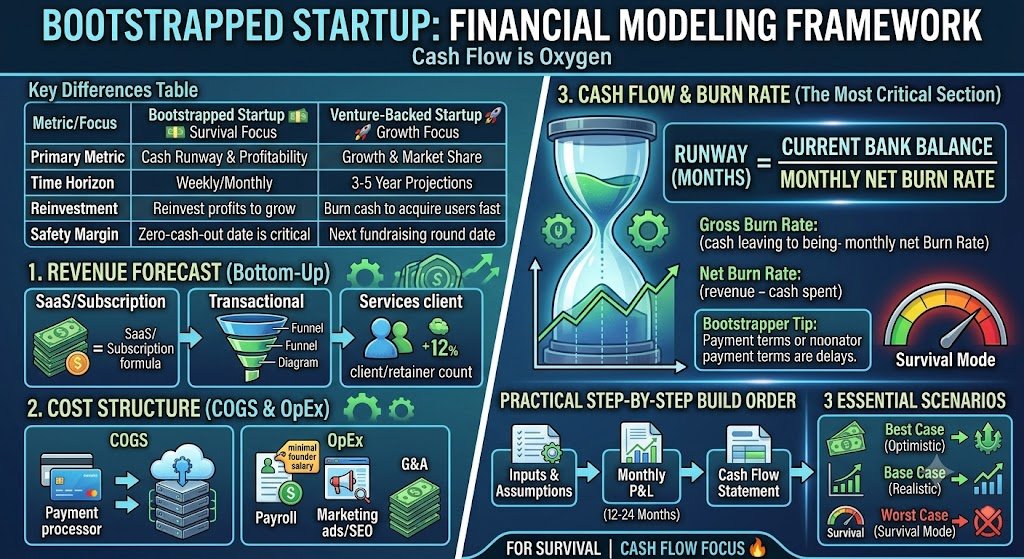

A founder can survive weak branding, a delayed feature, or a disappointing launch. Running out of cash is much harder to recover from.
That is why startup booted financial modeling matters. It turns a self-funded startup’s strategy into a practical monthly plan for revenue, expenses, hiring, marketing, taxes, cash reserves, and profitability. Instead of assuming another funding round will rescue the company, the model asks a tougher question: Can customer revenue support the next decision?
The phrase is commonly used as a search variation of bootstrapped startup financial modeling. In both cases, the purpose is the same: build around real cash generation, controlled spending, and measurable assumptions rather than optimistic fundraising scenarios. Recent pages ranking for the term also interpret it as financial forecasting for a startup funded mainly by founder capital and customer revenue.
What Is Startup Booted Financial Modeling?
Startup booted financial modeling is the process of forecasting how a self-funded startup will earn, spend, retain, and reinvest money over time.
A useful model projects:
- Customer or unit growth
- Pricing and revenue
- Cost of goods sold or service delivery
- Payroll and contractor costs
- Marketing expenses
- Software, rent, legal, and administrative costs
- Taxes and debt payments
- Monthly cash balance
- Break-even timing
- Base, downside, and upside scenarios
The model is not supposed to predict every future dollar perfectly. It is a decision system. A founder should be able to change one assumption, such as price, conversion rate, churn, salary, or advertising cost, and immediately see how that change affects profit and cash.
This driver-based approach is more useful than typing unsupported revenue figures into a spreadsheet. The U.S. Small Business Administration similarly recommends breaking forecasts into factors that can be tracked and comparing actual performance with the original plan.
Why Startup Booted Financial Modeling Is Different
A venture-backed startup may deliberately operate at a loss while using investor capital to hire quickly, acquire users, and enter new markets.
A bootstrapped company has less room for error. It may rely on founder savings, early customer payments, retained earnings, pre-orders, consulting income, or a small loan. That changes the priorities inside startup booted financial modeling.
| Financial Area | Bootstrapped Startup | Venture-Backed Startup |
|---|---|---|
| Primary funding | Founder cash and customer revenue | Investor capital |
| Main objective | Sustainable growth and survival | Rapid growth and market capture |
| Hiring | Triggered by affordability | Triggered by expansion targets |
| Marketing | Increased after validation | Often increased before profitability |
| Core question | Can revenue fund this decision? | Can capital accelerate this decision? |
Bootstrapping does not mean avoiding ambition. It means making growth financially supportable.
The strongest startup booted financial modeling process therefore prioritizes liquidity, contribution margin, payback periods, retention, and break-even visibility. Downloads, impressions, and registered users matter only when they connect to cash generation or strategic progress.
The Seven Parts of a Reliable Financial Model
A complicated spreadsheet is not automatically a good spreadsheet. For most early-stage companies, a clean monthly model covering 12 to 24 months is more useful than a five-year forecast filled with fragile assumptions. Good startup booted financial modeling keeps the logic visible enough for a founder to challenge every major input.
A practical startup booted financial modeling workbook can be divided into seven connected sections.
1. Assumptions
Create one clearly labeled assumptions tab. Do not hide critical inputs inside formulas scattered across different sheets.
Include:
- Starting cash
- Product price
- Average order value
- Monthly customer growth
- Conversion and churn rates
- Payment collection delay
- Refund rate
- Cost per lead
- Founder salary
- Hiring dates
- Tax reserve percentage
Use separate cells for assumptions and calculations. This makes the model easier to audit and reduces accidental errors.
2. Revenue Drivers
Revenue should be built from business activity, not wishful percentages.
For a subscription startup:
Monthly revenue = active customers × average monthly revenue per customer
For ecommerce:
Monthly revenue = website visitors × conversion rate × average order value
For a service business:
Monthly revenue = billable people × billable hours × hourly rate
The best startup booted financial modeling setup mirrors how the company actually earns money. If there are several products, customer segments, or price tiers, model them separately. One blended average can hide weak margins or declining customer quality.
3. Direct Costs and Gross Margin
Direct costs rise as sales increase. Depending on the business, they may include inventory, packaging, transaction fees, shipping, cloud infrastructure, onboarding, support labor, or subcontractor costs.
Calculate:
Gross profit = revenue − direct costs
Gross margin = gross profit ÷ revenue
Revenue alone does not pay overhead. A startup can grow sales quickly and still become financially weaker if each sale contributes too little after delivery costs.
For SaaS and subscription businesses, unit economics often include customer acquisition cost, lifetime value, and gross margin. These indicators help founders judge whether customer growth is economically sustainable.
4. Operating Expenses
Group expenses around real decisions:
- Founders and employees
- Contractors
- Marketing
- Software subscriptions
- Rent and utilities
- Legal and accounting
- Insurance
- Equipment
- Banking fees
- Taxes
- Debt repayments
Separate fixed, variable, and semi-variable costs. The SBA notes that break-even analysis depends on fixed costs, variable costs, selling price, and contribution margin.
Also include irregular expenses. Annual insurance, equipment replacement, legal filings, bonuses, and tax payments can create cash shortages even when an average month looks healthy.
5. Cash Flow
Profit and cash are not the same.
A company can record revenue before the customer pays. It can buy inventory months before a sale or pay annual software fees upfront. It can also owe taxes that have not yet left the bank.
For this reason, startup booted financial modeling needs a dedicated cash schedule:
Opening cash + cash received − cash paid = closing cash
Track when money actually enters and leaves the bank. SCORE cash-flow templates likewise organize forecasts around receipts, operating expenses, startup costs, compensation, capital spending, and ending cash balances.
6. Profit and Loss
The profit-and-loss forecast shows whether the operation is becoming economically viable.
At minimum, include revenue, cost of goods sold, gross profit, operating expenses, interest, taxes, and net profit or loss.
Review it monthly. SCORE’s 12-month P&L guidance presents projected income and expenses as a foundation for better financial decisions.
7. Founder Dashboard
The dashboard should fit on one screen and answer urgent questions quickly.
Track:
- Cash in bank
- Monthly revenue
- Gross margin
- Net cash flow
- Monthly burn
- Runway
- Break-even revenue
- Customer acquisition cost
- Customer lifetime value
- Churn or repeat rate
- Accounts receivable
- Forecast versus actual
A dashboard is not decoration. In startup booted financial modeling, every metric should point toward a decision.
How to Build Startup Booted Financial Modeling Step by Step
Step 1: Start With the Real Bank Balance
Enter the cash available to the business today. Exclude personal credit limits, possible investor money, unsigned contracts, and invoices not yet collected.
Every projected month should calculate from this starting point.
Step 2: Forecast Customers Before Revenue
Model leads or visitors, conversion rate, new customers, retained customers, lost customers, total active customers, and revenue per customer.
This creates a traceable connection between marketing activity and sales. It also makes weak assumptions easier to challenge.
Step 3: Forecast Collections, Not Only Sales
When customers pay immediately, revenue and cash receipts may be close.
When invoices are paid after 30, 45, or 60 days, the cash schedule must reflect that delay. Ecommerce models should include refunds, chargebacks, processing time, and inventory purchases. Subscription models should distinguish cash collected from revenue recognized.
Step 4: Add the Full Cost of Delivery
Include onboarding time, customer support, usage-based software, payment fees, fulfillment errors, returns, and contractor work.
This part of startup booted financial modeling often reveals that a popular product is less profitable than expected.
Step 5: Build a Hiring Schedule
Do not add a vague annual payroll percentage.
List each role, start month, salary, payroll taxes, benefits, equipment, recruitment cost, and software access. Include founder compensation too. A spreadsheet that assumes founders work forever for free can show artificial profitability.
Use milestone-based hiring rules:
- Hire support when ticket volume exceeds capacity
- Hire sales when lead flow is proven
- Hire engineering after a verified product bottleneck
- Increase founder pay after maintaining a defined cash reserve
Step 6: Calculate Break-Even
Break-even is the point where total revenue equals total costs.
For a single product, the SBA gives this formula:
Break-even units = fixed costs ÷ (selling price per unit − variable cost per unit)
For multiple products, calculate contribution margin by product or use a weighted average. Then convert the result into monthly revenue and customer targets.
Step 7: Build Three Scenarios
A single forecast creates false confidence.
Create:
- Base case: The most reasonable operating plan
- Downside case: Slower sales, higher costs, delayed collections, or more churn
- Upside case: Stronger conversion, pricing, retention, or demand
The downside case deserves the most attention. It should show when cash falls below the minimum reserve and which corrective action happens first.
Essential Startup Booted Financial Modeling Metrics
Cash Runway
Runway = cash balance ÷ average monthly net burn
Runway is a useful summary, but it becomes less reliable when revenue, spending, or seasonality changes sharply. Use the monthly cash schedule as the primary view.
Net Burn
Net burn = monthly cash outflows − monthly cash inflows
Gross burn shows total cash expenses. Net burn shows how much cash the business actually loses after collections.
Contribution Margin
Contribution margin = revenue − variable costs
It shows how much each sale contributes toward fixed costs and profit. Weak contribution margin cannot be repaired simply by increasing volume.
Customer Acquisition Cost
CAC = sales and marketing costs ÷ new customers acquired
Calculate CAC by channel. A blended average can hide an expensive paid channel behind low-cost referrals.
Customer Lifetime Value
LTV estimates the economic value created by a customer over the relationship.
Use gross profit rather than revenue when practical. A customer producing $1,000 in sales but requiring $800 in delivery and support is not worth $1,000 to the business.
CAC Payback Period
CAC payback = acquisition cost ÷ monthly gross profit per customer
A shorter payback returns cash faster, which is especially valuable in startup booted financial modeling because the company has limited reserves.
Revenue Concentration
Measure the percentage of revenue coming from the largest customer and the top five customers.
High concentration can make a startup look stable until one contract disappears. Model the cash impact of losing the largest account.
A Simple Startup Booted Financial Modeling Example
Assume a subscription startup begins with $75,000 in cash.
Its base assumptions are:
- Subscription price: $80 per month
- Starting customers: 100
- New customers per month: 20
- Monthly churn: 4%
- Gross margin: 75%
- Monthly operating expenses: $18,000
- Initial monthly revenue: $8,000
The company initially loses cash. The founder can now test practical changes:
- Raise the price from $80 to $89
- Reduce churn from 4% to 3%
- Delay a $6,000 monthly hire
- Improve conversion without increasing advertising
- Collect annual subscriptions upfront
- Remove unused software and contractor spending
The value of startup booted financial modeling is not finding one magical forecast. It is seeing which combination of decisions protects cash while preserving growth.
Common Mistakes That Make the Model Unreliable
Even careful startup booted financial modeling can become misleading when the underlying assumptions are vague, outdated, or disconnected from actual operations.
Using Top-Down Revenue
“Capture 1% of the market” is not an operating forecast. Translate market opportunity into leads, conversions, customers, order frequency, price, and retention.
Treating Profit as Cash
A profitable month can still produce negative cash flow because of unpaid invoices, inventory, debt payments, taxes, equipment, or prepaid expenses.
Ignoring Founder Costs
A model that assumes founders never receive compensation understates the true operating cost.
Hiding Assumptions in Formulas
When assumptions are buried across the workbook, startup booted financial modeling becomes difficult to test and easy to break.
Forecasting One Perfect Scenario
Real companies experience delayed payments, failed campaigns, price resistance, churn, and surprise costs. Scenario planning turns those risks into visible choices.
Updating Only When Cash Is Low
Compare actual results with the model every month and investigate meaningful differences. This plan-versus-actual process is a standard forecasting discipline in SBA guidance.
Turn the Model Into Decision Rules
The model should create rules before emotion enters the decision.
Examples:
- Hire only when the downside case preserves a minimum cash reserve
- Increase ad spend only after a channel proves profitable across several cohorts
- Launch a product only after estimating delivery and support costs
- Offer annual discounts only when the cash benefit justifies the margin reduction
- Enter a new market only when the core operation remains stable
- Take founder distributions only after taxes and reserves are funded
This is where startup booted financial modeling becomes more than accounting. It translates strategy into measurable conditions.
How Often Should the Model Be Updated?
Update actual financial results at least monthly.
A fast-moving company may update cash and sales weekly while reviewing the full startup booted financial modeling forecast each month. Reforecast whenever pricing, headcount, churn, a large contract, tax exposure, or product strategy changes.
Use a rolling forecast. When one month ends, add another month so the planning horizon remains useful.
Conclusion: Make Every Dollar Answer a Question
Startup booted financial modeling gives a self-funded founder something more valuable than a polished spreadsheet: time to act.
It shows when cash pressure is approaching, which products produce real margin, how much growth the company can afford, and what must improve before hiring or increasing spending. It replaces vague confidence with measurable operating rules.
Start with the actual bank balance. Build revenue from customer drivers. Separate profit from cash. Calculate break-even. Test the downside case. Compare the forecast with actual results every month.
A model will never remove uncertainty. It will help you see uncertainty early enough to make a better decision.
Frequently Asked Questions
1. What does startup booted financial modeling mean?
Startup booted financial modeling means forecasting the revenue, expenses, profitability, and cash flow of a bootstrapped or self-funded startup. It assumes the business will rely mainly on founder capital and customer-generated cash instead of future venture funding.
2. What should the model include?
It should contain assumptions, customer and revenue drivers, direct costs, operating expenses, payroll, cash flow, profit and loss, break-even analysis, scenarios, and a dashboard. The most urgent output is usually the projected monthly cash balance.
3. How many years should the model cover?
For operating decisions, a detailed monthly forecast covering 12 to 24 months is usually practical. A three-year view may help with lending or long-term planning, but later periods should be treated as directional. SCORE provides 12-month, 24-month, and multi-year formats for different planning needs.
4. Can a profitable startup still run out of cash?
Yes. Profit follows accounting treatment, while cash flow tracks actual money entering and leaving the bank. Slow customer payments, inventory, loan repayments, taxes, equipment, and prepaid costs can produce a shortage even when the income statement shows profit.
5. What is the most important startup booted financial modeling metric?
The projected cash balance is often the most urgent metric because it shows whether the company can keep operating. It should still be read alongside gross margin, contribution margin, net burn, runway, acquisition cost, retention, and break-even revenue.