


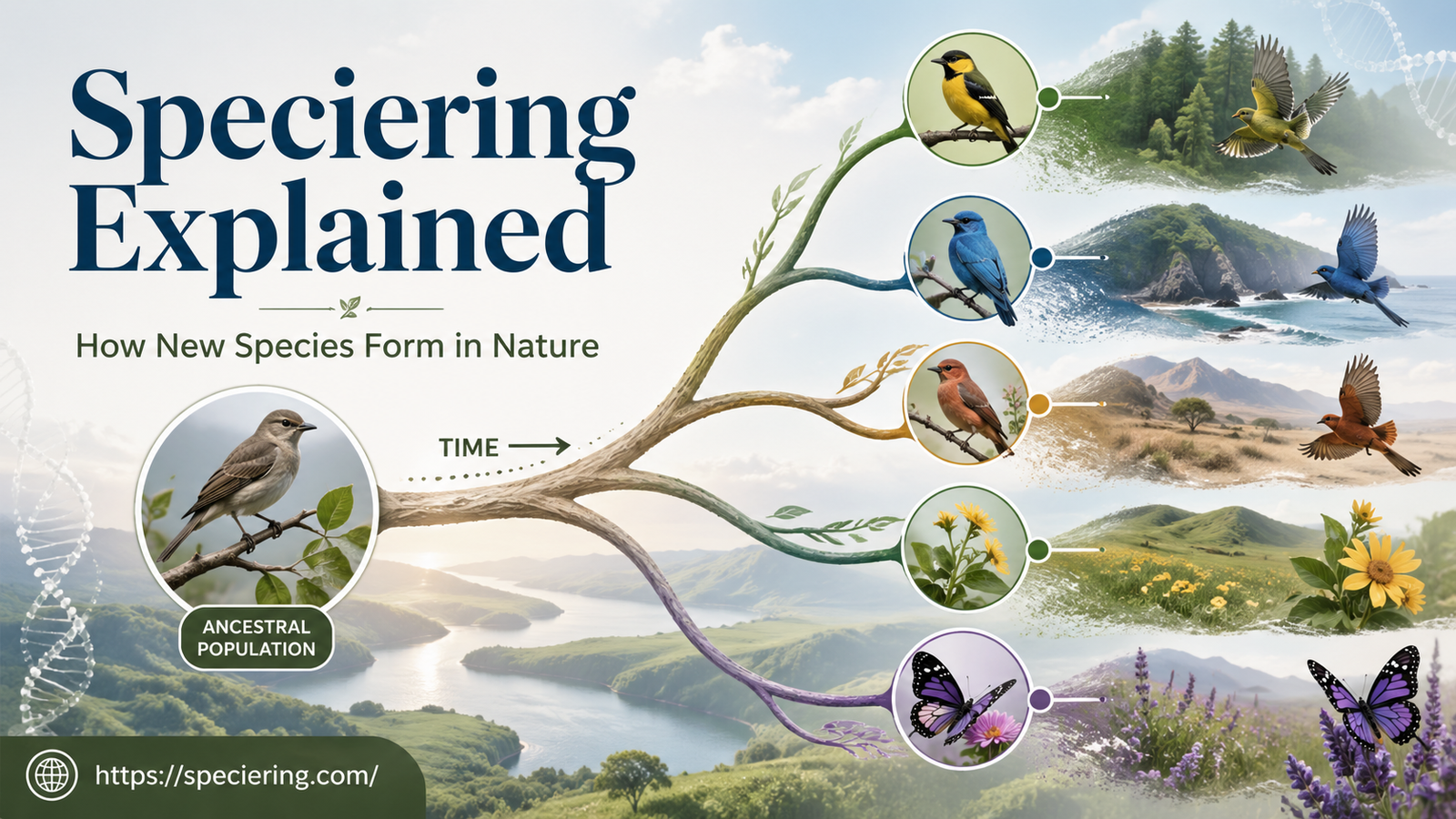
Speciering is best understood as the process of speciation, meaning the formation of new biological species. In simple words, it explains how one group of living things can slowly become two or more different species over time. Standard biology sources define speciation as the process by which new species develop during evolution.
This topic matters because life on Earth is always changing. Animals, plants, fungi, and microbes face new climates, new predators, new food sources, and new habitats. Over many generations, these pressures can shape populations in different ways. Eventually, two groups may become so different that they can no longer successfully breed with each other. That is when a new species has formed. Britannica explains that species are often understood as natural populations that can interbreed and are reproductively isolated from other such groups.
What Is Speciering?
Speciering refers to the long natural journey through which populations split, adapt, and become distinct species. A species is commonly described as a group of organisms that can mate with one another and produce viable, fertile offspring. Khan Academy uses this student-friendly explanation when teaching species and speciation.
Think of it like a family tree. At one point, two groups may share the same ancestor. But if they live in different places, eat different foods, attract different mates, or survive under different conditions, they may slowly grow apart. After enough time, their genes, bodies, behaviors, or breeding patterns may become too different to stay as one species.
This does not usually happen overnight. In many cases, it takes thousands or even millions of years. However, the basic idea is simple: populations change, barriers form, and new species appear.
Simple Meaning of Species Formation
Species formation begins with variation. No two living things are exactly the same. Some birds may have longer beaks. Some insects may resist cold better. Some flowers may bloom earlier than others. These small differences can matter a lot when the environment changes.
When a helpful trait allows an organism to survive and reproduce, that trait can become more common in later generations. This is natural selection. Over time, a population may become better suited to its local environment. If another population of the same original species adapts in a different direction, the two groups may slowly become separate.
Why Reproductive Isolation Matters
Reproductive isolation is one of the biggest ideas in speciation. It means two groups can no longer mate successfully, or they do not produce fertile offspring. This isolation may happen before mating or after mating.
Before mating, species may be separated by place, time, behavior, or physical differences. For example, two frog populations may call for mates at different times of night. Two flowers may attract different pollinators. Two insects may live on different host plants.
After mating, problems may still occur. The offspring may not survive well, or they may be sterile. These barriers help keep species separate once they have formed.
How Speciering Starts in Nature
Speciation often begins when one population is divided into two or more groups. Lumen Learning explains that, for speciation to occur, populations must evolve in a way that makes interbreeding impossible between the new groups.
The split may be caused by a mountain range, river, desert, glacier, island, or even human-made habitat change. Once groups are separated, they stop sharing genes as freely. From there, evolution can take them in different directions.
Genetic Variation and Mutation
Genetic variation is the raw material of evolution. Mutations, gene mixing during reproduction, and random genetic differences create variety inside populations. Most changes are small. Some are harmful. Others may be useful when the environment changes.
For example, a mutation that helps an insect digest a new plant may give it an advantage. If that insect and its offspring keep feeding on that plant, they may slowly become different from insects that feed elsewhere.
Natural Selection and Survival
Natural selection works like a filter. Organisms with traits that help them survive and reproduce tend to pass those traits forward. Over many generations, this can reshape an entire population.
In dry regions, plants that store water well may survive better. In cold places, animals with thicker fur may have an advantage. In crowded forests, birds with songs that carry through dense trees may attract more mates.
Genetic Drift in Small Populations
Genetic drift is random change in gene frequencies. It is especially powerful in small populations. A small group that becomes isolated may not carry all the genetic variety of the original population.
Imagine a few lizards reaching a new island after a storm. By chance, they may have unusual colors, sizes, or behaviors. Their descendants may carry those traits, not because the traits were better at first, but because the founding group was small. Over time, natural selection and drift may both shape the island population.
Main Types of Speciation
Scientists often explain species formation through several main patterns. These patterns are not just textbook labels. They help researchers understand how geography, ecology, behavior, and genetics work together.
| Type | Simple Meaning | Common Cause |
|---|---|---|
| Allopatric speciation | Species form in different places | Geographic barriers |
| Sympatric speciation | Species form in the same area | Ecological or genetic separation |
| Parapatric speciation | Neighboring groups diverge | Environmental gradients |
| Peripatric speciation | A small isolated group changes | Founder effect |
Allopatric Speciation
Allopatric speciation happens when populations are separated by geography. A river may divide insects. A mountain range may split mammals. An island may isolate birds from the mainland.
Once separated, the groups experience different conditions. One side may be wetter, colder, darker, or richer in food. Over time, each group adapts to its own setting. If they meet again later but can no longer breed successfully, they have become different species.
Sympatric Speciation
Sympatric speciation happens without a physical barrier. The populations live in the same general area, but they become separated in another way.
This can happen when organisms use different food sources, breed at different times, or choose different mates. It is common in some plants, especially when chromosome changes create instant reproductive barriers.
Parapatric Speciation
Parapatric speciation happens when populations live next to each other but face different environmental pressures. There may be some gene flow, but not enough to keep the groups fully alike.
For example, grasses growing near polluted soil may adapt to heavy metals, while nearby grasses on normal soil remain different. Over time, these neighboring groups may become reproductively isolated.
Peripatric Speciation
Peripatric speciation is similar to allopatric speciation, but it usually involves a small group at the edge of a larger population. Because the group is small, genetic drift can act strongly.
A small founding population may enter a new habitat, such as an island, cave, or isolated valley. With fewer individuals, random genetic effects and local selection can move quickly. This can lead to fast divergence compared with a large, stable population.
Real-World Examples of New Species Formation
Speciation helps explain the incredible variety of life on Earth. Researchers connect it to biodiversity because new species formation is one of the major reasons Earth has so many different organisms. One scientific review notes that speciation is ultimately responsible for much of the biodiversity seen on Earth.
Island Species and Adaptive Radiation
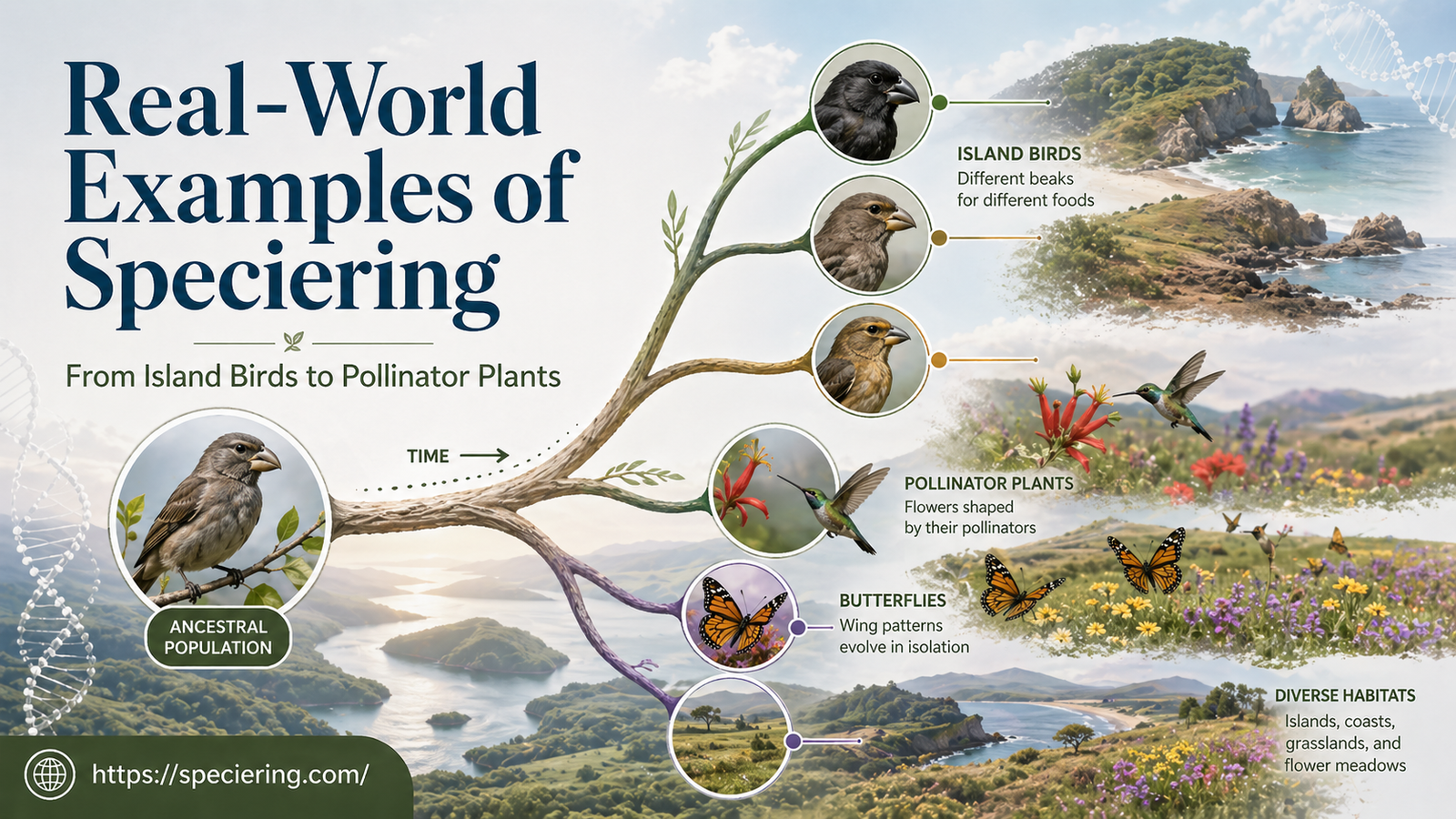
Islands are famous natural laboratories for evolution. When organisms reach an island, they often find open habitats and fewer competitors. Over time, one ancestral species may split into several species, each adapted to a different lifestyle. This pattern is called adaptive radiation.
Birds may evolve different beak shapes for seeds, insects, or nectar. Lizards may adapt to tree trunks, grasses, or rocks. Plants may change flower shapes to match local pollinators.
Plants, Pollinators, and Hybrid Zones
Plants often show fascinating speciation patterns. Some become isolated because they attract different pollinators. A flower visited by bees may evolve one color and scent, while a related flower visited by birds may evolve another.
Hybrid zones also matter. These are places where related species meet and sometimes breed. In some cases, hybrids are less fit, which strengthens separation between the species. In other cases, hybridization may introduce useful genes or even help form new plant lineages.
Why Speciering Matters for Biodiversity
Speciering matters because it explains where biodiversity comes from. Without speciation, life would not branch into the rich variety we see today. Forests, oceans, grasslands, deserts, and wetlands are full of organisms that exist because ancestral populations changed and split over time.
Biodiversity also supports healthy ecosystems. Different species pollinate plants, recycle nutrients, clean water, control pests, and provide food for other organisms. When species disappear, ecosystems may become weaker and less stable.
Conservation and Climate Change
Understanding speciation can help conservation. If scientists know how species form, adapt, and remain separate, they can make better choices about protecting habitats and genetic diversity.
Climate change adds pressure. As temperatures rise and habitats shift, some populations may move, adapt, or decline. Protecting connected habitats can help species track suitable climates. Protecting isolated habitats can also matter because unique populations may hold rare genetic traits.
For a clear beginner-friendly guide, Khan Academy’s lesson on species and speciation is a useful external resource.
Common Myths About Speciation
Myth 1: New species appear suddenly in most cases
Most new species form gradually. While some plants can become reproductively isolated quickly through chromosome changes, many animals and plants diverge over long periods.
Myth 2: Evolution always creates “better” organisms
Evolution does not aim for perfection. It favors traits that work in a specific environment. A trait that is helpful in one place may be useless or harmful somewhere else.
Myth 3: Species are always easy to define
Species can be tricky. Some organisms look different but can still breed. Others look almost the same but are genetically or reproductively separate. This is why scientists use several species concepts, including biological, morphological, ecological, and phylogenetic approaches.
FAQs About Speciering
1. What does Speciering mean?
Speciering means the formation of new species through evolution. It is closely related to the scientific term speciation, which describes how populations become distinct species over time.
2. Is speciation the same as evolution?
Speciation is part of evolution. Evolution means populations change over generations. Speciation is the point where those changes lead to one species becoming two or more separate species.
3. What is the most common cause of speciation?
Geographic isolation is one of the best-known causes. When populations are separated by mountains, rivers, oceans, or other barriers, they may evolve independently and become different species.
4. Can new species form in the same place?
Yes. This is called sympatric speciation. It can happen when groups in the same area use different resources, breed at different times, choose different mates, or develop genetic barriers.
5. Why is reproductive isolation important?
Reproductive isolation keeps species separate. If two groups cannot mate successfully or cannot produce fertile offspring, they are no longer part of the same breeding population.
6. Does speciation still happen today?
Yes. Speciation is an ongoing natural process. Populations continue to adapt, shift, split, and change as environments change.
7. Why should students learn about speciation?
Students should learn about speciation because it explains biodiversity, adaptation, extinction, conservation, and the history of life on Earth.
Conclusion
Speciation is one of nature’s most powerful creative processes. It explains how life branches, adapts, and fills the planet with extraordinary diversity. From island birds to flowering plants, from isolated valleys to changing climates, the formation of new species shows that life is never standing still.
By understanding Speciering, we gain a clearer view of evolution, biodiversity, and conservation. It helps us see that every species has a story, every habitat matters, and every population may carry the seeds of future diversity.
