

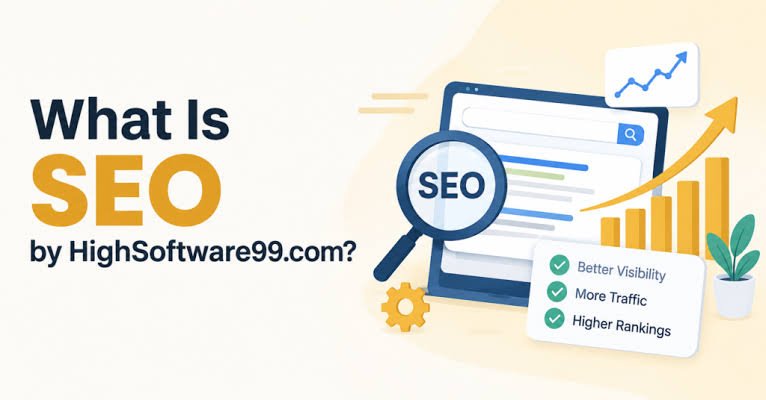
SEO by HighSoftware99.com refers to a search-visibility approach associated with HighSoftware99.com, with a particular emphasis on Google Autocomplete/ATC visibility alongside broader SEO concepts such as technical optimization, content, keyword targeting, and digital visibility. The official HighSoftware99.com website currently promotes a service intended to boost keywords through Google Autocomplete and states that visibility can occur within approximately 3–12 hours. That is a claim made by the service provider, not a Google guarantee.
That distinction matters.
Autocomplete visibility, page indexing, and organic ranking are three different search outcomes. Google explains that Autocomplete predictions are automatically generated from signals such as real searches, language, location, trending interest, and—in some situations—past searches.
For a business considering SEO services, understanding that difference is the starting point for making a sensible decision.
What Is SEO by HighSoftware99.com?
SEO by HighSoftware99.com is best understood as a search-visibility service rather than a guaranteed shortcut to first-page rankings.
The main HighSoftware99.com website describes its offering around Google Autocomplete, sometimes referred to as ATC, and presents the service as a way to increase the visibility of selected keywords in search suggestions. The same site also presents broader digital services, including SEO/SEM, content creation, social media management, brand strategy, web design, and digital marketing.
This positioning makes the service particularly interesting for businesses concerned with brand discovery before a search is completed.
Traditional SEO usually concentrates on what happens after a person enters a query and receives search results. Autocomplete operates earlier in the journey: a person starts typing, Google displays predictions, and the user may select one of those suggestions.
That is a meaningful distinction.
SEO by HighSoftware99.com and the Autocomplete Concept
Google describes Autocomplete as a feature designed to make searches faster by predicting what someone may be trying to type. Its systems consider real searches and several contextual signals, including language, location, and trending interest.
This means an autocomplete suggestion should not automatically be interpreted as an organic ranking position.
For example:
- A phrase may appear as an autocomplete suggestion.
- A user may select that suggestion.
- Google then processes the completed query.
- Search results are generated from Google’s index.
- The resulting page ranking can be completely different from the autocomplete position.
Autocomplete and organic rankings belong to different parts of the search experience.
That is one of the most important points for anyone researching this service.
How Does SEO by HighSoftware99.com Differ From Traditional SEO?
Conventional SEO generally covers a much wider technical and content workflow.
Google’s own documentation describes SEO as helping search engines understand content and helping users discover websites through search. Google recommends attention to crawling, indexing, structured data, site architecture, content quality, and Search Console monitoring.
A broader SEO campaign can therefore include:
| SEO Area | Primary Purpose | Typical Measurement |
|---|---|---|
| Keyword research | Identify relevant search demand | Queries, impressions |
| Search intent | Match content to what users want | Engagement, conversions |
| Technical SEO | Remove crawling and usability barriers | Indexing, Core Web Vitals |
| On-page SEO | Improve page relevance and clarity | Rankings, impressions |
| Content strategy | Build useful topical coverage | Organic traffic |
| Internal linking | Connect related pages | Crawlability, page discovery |
| Digital PR/link acquisition | Develop authority and discovery | Referring domains |
| Local SEO | Improve location-based visibility | Local impressions/actions |
| Autocomplete visibility | Influence search suggestions | Presence of selected predictions |
| Search Console monitoring | Track Google Search performance | Queries, clicks, CTR |
The key lesson is simple: one visibility signal should not be treated as the entire SEO system.
What Does HighSoftware99.com Publicly Claim?
The official HighSoftware99.com website currently emphasizes Google Autocomplete services and says targeted keywords can be boosted through autocomplete within 3–12 hours.
That timeframe is part of the company’s public marketing claim.
It should be evaluated separately from Google’s documentation.
Google states that its search systems are automated and that Google does not guarantee that a page will be crawled, indexed, or served in search results. Google also states that payment does not buy higher organic rankings.
This creates an important evaluation framework:
Provider claim: rapid autocomplete visibility.
Google reality: search crawling, indexing, and serving are separate processes that depend on many factors.
Practical interpretation: fast autocomplete visibility should not be presented as proof of an instant first-page organic ranking.
That is a more accurate way to understand the service.
SEO by HighSoftware99.com: Autocomplete vs. Ranking
One of the easiest mistakes in modern SEO is treating every search feature as a ranking position.
Imagine a user types:
best accounting software for startups
Google may display several predictions before the user presses Enter.
Those predictions help the user formulate the search. Once the user selects one, Google then retrieves and ranks relevant information.
Google describes Search as a process involving crawling, indexing, and serving search results.
Autocomplete sits earlier in the user journey.
That means a marketer should track at least two separate questions:
- Does the desired phrase appear in autocomplete?
- What pages rank when that phrase is actually searched?
A successful answer to the first question does not automatically answer the second.
Why Search Intent Still Matters
Even a technically impressive visibility campaign cannot compensate for content that fails to satisfy the user’s reason for searching.
Google’s Search Essentials recommends creating helpful, reliable, people-first content and using words that users would naturally use to find the information.
Search intent generally falls into several practical categories:
- Informational: The user wants an explanation.
- Commercial: The user is researching a product or service.
- Transactional: The user is ready to purchase or take action.
- Navigational: The user is looking for a particular website or brand.
- Local: The user wants a service or business in a particular area.
A keyword can have multiple layers of intent.
For example, someone searching a branded phrase may initially want basic information. Another person may be comparing providers. A third may already be ready to contact the company.
Strong SEO accounts for those differences.
Technical SEO Remains the Foundation
Fast visibility means little if Google cannot properly access, understand, or index the underlying website.
Google’s developer documentation recommends checking whether Googlebot can access important pages, using crawlable links, maintaining a sitemap where appropriate, and checking technical barriers such as robots.txt and noindex directives.
A practical technical audit should examine:
- Indexability — Can important pages enter Google’s index?
- Crawlability — Can Googlebot reach those pages?
- Canonicalization — Are duplicate URL versions handled properly?
- Mobile usability — Does the site work effectively across devices?
- Page performance — Are important pages technically efficient?
- Internal links — Can users and crawlers discover related pages?
- Structured data — Is relevant information marked up correctly?
- Status codes — Are important URLs returning the expected responses?
- Robots directives — Are important resources accidentally blocked?
- Sitemap quality — Does the sitemap accurately represent useful URLs?
These are durable SEO fundamentals.
They remain relevant regardless of which SEO provider a company chooses.
Content Quality Is Where Sustainable SEO Develops
A page targeting a keyword should answer the question behind that keyword.
That sounds obvious. Many websites still miss it.
A useful page should provide enough context for a reader to complete the next step without immediately returning to Google to ask the same question in another way.
For an authority page, that can mean including:
- Definitions
- Practical examples
- Comparisons
- Step-by-step explanations
- Original observations
- Relevant data
- Expert commentary
- Common mistakes
- Frequently asked questions
- Clear next actions
Google’s Search Essentials specifically recommends people-first content rather than pages designed primarily to manipulate search rankings.
That principle is especially relevant when evaluating any service promising rapid visibility.
Semantic SEO and Topic Coverage
Modern SEO is not simply about repeating an exact keyword.
A page about SEO may naturally discuss:
technical SEO, keyword research, search intent, crawling, indexing, internal links, structured data, content quality, Search Console, organic traffic, local SEO, backlinks, entity relevance, user experience, and search visibility.
Those concepts help establish topical context.
The goal is not to insert every related phrase into a paragraph.
The goal is to answer the subject comprehensively enough that both users and search systems can understand the page’s purpose.
Google’s SEO documentation emphasizes helping search engines understand content and making pages easier to crawl and index.
How to Evaluate an SEO Service Before Paying
If you’re considering SEO by HighSoftware99.com, evaluate the exact deliverable rather than relying on a broad promise of visibility.
Ask these questions first:
1. What exactly is being optimized?
Is the service targeting:
- Google Autocomplete?
- Organic rankings?
- Indexing?
- Technical SEO?
- Local search?
- Brand visibility?
- Content?
- Backlinks?
Get the answer in writing.
2. What evidence will be provided?
A useful reporting system should show measurable information rather than screenshots selected only to demonstrate success.
For organic SEO, Search Console can provide information about search performance, including queries, clicks, impressions, and other website-search data. Google describes Search Console as a tool for website owners and SEO professionals to understand how their sites perform in Google Search.
3. What happens after the initial result?
A short-term visibility event is different from sustainable organic growth.
Ask whether monitoring, technical maintenance, content updates, and strategy adjustments are included.
4. What is the exact timeframe?
Avoid interpreting a rapid visibility statement as a universal ranking guarantee.
Google itself notes that SEO changes can take different amounts of time, ranging from hours in some cases to months in others.
5. What happens if results change?
Search systems evolve.
A professional campaign should have a monitoring process rather than assuming that one successful snapshot represents permanent performance.
A Practical Measurement Framework
A strong SEO campaign should be measured using several layers.
Visibility metrics show whether people can discover the brand or content.
Search metrics show how often pages appear and receive clicks.
Engagement metrics indicate whether visitors find the landing page useful.
Business metrics reveal whether that traffic produces leads, sales, registrations, calls, or another meaningful outcome.
Consider this framework:
| Measurement Layer | Example Metrics | What It Tells You |
|---|---|---|
| Discovery | Indexed URLs, autocomplete presence | Whether users can encounter the brand |
| Search visibility | Impressions, average position | Whether pages appear for queries |
| Traffic | Organic clicks, sessions | Whether visibility generates visits |
| Engagement | Engagement rate, returning visitors | Whether visitors find value |
| Conversion | Leads, sales, signups | Whether traffic supports business goals |
| Technical health | Indexing errors, performance | Whether technical barriers exist |
| Content | Ranking pages, query coverage | Which topics attract demand |
| Brand | Branded searches, mentions | Whether recognition is increasing |
This prevents one metric from dominating the entire evaluation.
Is Rapid Search Visibility the Same as Instant SEO?
No.
The phrase instant SEO can create unrealistic expectations because SEO consists of multiple processes.
Google explains that crawling means discovering and accessing pages. Indexing means analyzing and storing information about those pages. Serving means selecting relevant information when a person searches.
Those stages are connected.
They are not identical.
A page can be crawled without immediately ranking highly. A page can be indexed without receiving significant traffic. A keyword can become visible in a search feature without producing meaningful conversions.
This is why experienced marketers look beyond screenshots.
They measure the entire funnel.
Common Mistakes When Assessing SEO by HighSoftware99.com
Mistake 1: Treating autocomplete as an organic ranking
Autocomplete is a search prediction feature. Google says its predictions are generated using multiple signals and should not be confused with Google Trends or traditional search rankings.
Mistake 2: Assuming indexing equals ranking
It does not.
Google can index a page while still determining that another page is more relevant for a particular query.
Mistake 3: Measuring only one keyword
One phrase rarely represents an entire business.
A better campaign monitors a cluster of related queries and the pages serving those queries.
Mistake 4: Ignoring the website itself
Technical problems, weak content, poor internal architecture, and confusing navigation can undermine search performance.
Mistake 5: Buying based on a guarantee
Google explicitly says it does not guarantee crawling, indexing, or search-result serving.
A provider should therefore explain its methodology and deliverables instead of presenting Google’s behavior as completely controllable.
Who Might Be Interested in This Service?
The approach may attract several types of website owners.
Small businesses may be interested in increasing brand discovery without building a large internal SEO team.
Startups may care about establishing recognition around a new brand or product.
Digital marketers may investigate autocomplete visibility as an additional search-discovery channel.
Established companies may explore branded search visibility as part of a wider reputation and acquisition strategy.
The right use depends on the campaign objective.
There is no reason to treat autocomplete optimization as a replacement for technical SEO, useful content, conversion optimization, and broader search strategy.
What a Responsible SEO Strategy Should Look Like
A well-rounded campaign can follow this sequence:
- Audit the existing website.
- Identify technical indexing problems.
- Map keywords to search intent.
- Build or improve core landing pages.
- Create supporting topical content.
- Strengthen internal linking.
- Improve structured data where appropriate.
- Build legitimate awareness and references.
- Track organic search performance.
- Review conversions rather than rankings alone.
- Update content as search intent changes.
- Remove weak or unnecessary pages when appropriate.
This is much more durable than chasing a single search feature.
Google’s own guidance similarly emphasizes technical accessibility, helpful content, crawlable links, structured data where relevant, and Search Console monitoring.
SEO by HighSoftware99.com: What Should You Verify?
Before purchasing any campaign, create a simple verification checklist.
Service scope: What exactly will be delivered?
Target: Which keywords, URLs, markets, or search features are involved?
Evidence: How will performance be independently measured?
Timeline: Which outcomes are expected quickly and which require longer-term development?
Maintenance: What happens after the initial campaign?
Risk management: Does the strategy comply with search-engine guidelines?
Reporting: Will the client receive meaningful performance data?
Ownership: Does the client retain control of the website, analytics, Search Console, content, and other assets?
These questions turn a vague SEO promise into a measurable commercial service.
Expert Verdict: How to Approach the Service
SEO by HighSoftware99.com is most clearly associated with Google Autocomplete/ATC visibility, while broader SEO involves technical health, content, relevance, authority, and ongoing measurement. The official site promotes rapid autocomplete visibility, but that should be treated as a provider claim rather than a guaranteed Google ranking outcome.
For website owners, the sensible approach is to separate the deliverables.
If the objective is autocomplete exposure, measure autocomplete exposure.
If the objective is organic traffic, measure impressions, clicks, rankings, landing-page performance, and conversions.
If the objective is technical SEO, measure crawlability, indexation, performance, and technical errors.
If the objective is brand growth, measure branded demand and business outcomes.
That separation makes SEO easier to evaluate and prevents a visually impressive search feature from being mistaken for total search performance.
Google’s own guidance provides the broader foundation: make content useful for people, ensure Google can crawl and understand important pages, follow Search Essentials, and monitor performance through Search Console.
The strongest long-term strategy is therefore not about finding one magic ranking signal.
It is about building a website that deserves to be discovered, understood, selected, and revisited.
Frequently Asked Questions
1. What is SEO by HighSoftware99.com?
SEO by HighSoftware99.com refers to SEO and search-visibility services associated with HighSoftware99.com. Its official website currently places particular emphasis on Google Autocomplete/ATC and states that targeted keywords can be boosted through autocomplete within 3–12 hours.
2. Does SEO by HighSoftware99.com guarantee first-page Google rankings?
A rapid autocomplete visibility claim should not be interpreted as a guarantee of first-page organic rankings. Google states that it does not guarantee that pages will be crawled, indexed, or served in search results, and organic ranking is determined programmatically.
3. Is Google Autocomplete the same as Google ranking?
No. Autocomplete helps users complete searches before they submit a query, while organic ranking determines which indexed pages Google displays after a search is performed. Google says autocomplete predictions use signals including real searches, language, location, trending interest, and sometimes previous searches.
4. How long does SEO normally take to show results?
There is no universal timeframe. Google notes that some changes can be reflected within hours, while others can take several months. The time depends on the change, website, competition, crawling, indexing, content, and other factors.
5. What should I check before hiring an SEO provider?
Ask for a clear scope of work, target keywords or URLs, methodology, reporting process, timeframe, technical deliverables, ownership arrangements, and evidence of performance. For organic search, use independent data such as Google Search Console rather than relying exclusively on provider screenshots or marketing claims. Google identifies Search Console as a primary tool for monitoring a site’s performance in Google Search.
