


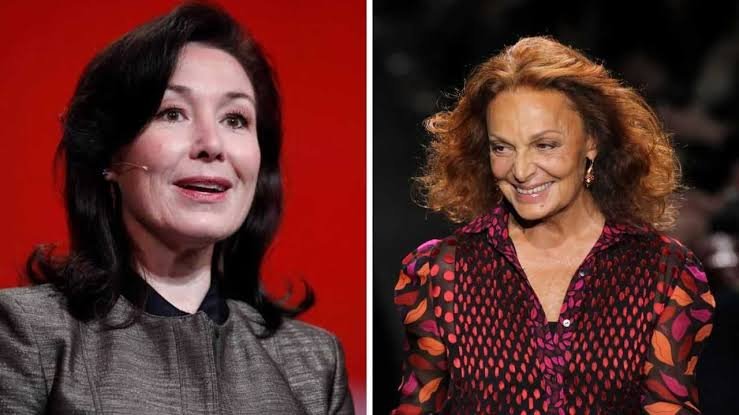
Safra Catz and Diane von Furstenberg are two internationally recognized business figures whose names have appeared together in prominent coverage of successful foreign-born women in the United States. Their professional worlds are very different: Catz built her reputation in enterprise technology, finance, and corporate leadership, while von Furstenberg became a fashion icon through design, entrepreneurship, and the creation of the famous wrap dress. The interesting question is therefore not whether they built the same business, but why their names are associated and what their individual careers reveal about leadership, entrepreneurship, and influence.
There is an important distinction to make at the beginning. Publicly available authoritative sources document major achievements for both women, but they do not establish a joint company, family relationship, or formal business partnership between Safra Catz and Diane von Furstenberg. Their strongest documented connection comes from lists and profiles that placed successful immigrant or foreign-born women together.
Who Are Safra Catz and Diane von Furstenberg?
The easiest way to understand Safra Catz and Diane von Furstenberg is to examine their careers independently before looking at the historical reason they became associated.
Safra Catz is a senior technology and corporate executive whose career has been closely connected with Oracle. Oracle’s current executive biography identifies her as executive vice chair of the Oracle board, following earlier roles that included CEO, president, CFO, executive vice president, and senior vice president.
Diane von Furstenberg is a Belgian-born fashion designer, entrepreneur, author, and philanthropist best known for creating the wrap dress, a design that became one of the defining fashion products of the 1970s. Her own company describes her as the founder of the DVF brand and the creator of the iconic wrap dress.
So the comparison begins with contrast:
| Category | Safra Catz | Diane von Furstenberg |
|---|---|---|
| Primary industry | Enterprise technology | Fashion and lifestyle |
| Best-known organization | Oracle | Diane von Furstenberg / DVF |
| Birth country | Israel | Belgium |
| Major professional identity | Corporate executive | Designer and entrepreneur |
| Signature achievement | Long-term Oracle leadership | Creation of the wrap dress |
| Career emphasis | Finance, operations, technology strategy | Design, branding, fashion entrepreneurship |
| Documented Forbes connection | Foreign-born self-made women coverage | Foreign-born self-made women coverage |
| Joint company identified | No verified joint company | No verified joint company |
The table shows why treating them as identical business personalities would be misleading. Their influence developed through very different mechanisms.
Why Do Safra Catz and Diane von Furstenberg Appear Together?
The clearest documented explanation comes from Forbes coverage of foreign-born women who built significant fortunes in the United States.
In a 2015 Forbes feature, the publication highlighted foreign-born members of its ranking of America’s self-made women. Safra Catz was identified as being born in Israel and associated with Oracle, while Diane von Furstenberg was identified as being born in Belgium and associated with DVF. Forbes estimated their fortunes at $525 million and $450 million respectively at that time. Those figures are historical estimates and should not be interpreted as current wealth figures.
Forbes repeated the association in its 2016 coverage of foreign-born self-made women. Catz appeared with an estimated $510 million and von Furstenberg with $340 million in that year’s historical estimates.
This matters because search results can sometimes turn a shared list appearance into an apparent personal connection.
That is not the same thing.
A list can put two people in the same article because they satisfy a common criterion. It does not establish that those people know each other, work together, share investments, or have a personal relationship.
Safra Catz: From Investment Banking to Oracle Leadership
Safra Catz’s career provides a useful case study in how financial expertise can become a foundation for technology leadership.
Before joining Oracle, Catz worked at Donaldson, Lufkin & Jenrette, where she held investment-banking positions and eventually became a managing director. Oracle’s official biography confirms that she previously worked there before joining Oracle.
She joined Oracle in 1999 and eventually moved through several executive positions.
Her career at Oracle included:
- Senior vice president
- Executive vice president
- President
- Chief financial officer
- Chief executive officer
- Executive vice chair of the board
Oracle’s current biography confirms the breadth of these responsibilities.
Her career is particularly notable because she combined financial expertise with large-scale corporate management.
That combination became highly relevant as Oracle expanded through acquisitions, cloud infrastructure, enterprise software, and broader technology services.
The U.S. Securities and Exchange Commission’s historical Oracle filing described Catz’s responsibilities as covering Oracle operations outside product development and engineering and highlighted her experience with the company’s strategy, management, and operations.
Why Catz’s Career Matters
Catz’s story illustrates a less visible form of executive influence.
Fashion entrepreneurs often have a recognizable product. Technology executives frequently operate through systems that customers never see directly.
For Catz, the relevant systems included corporate finance, acquisitions, operational management, enterprise software, and organizational strategy.
That difference is important when comparing her with a designer such as Diane von Furstenberg.
Diane von Furstenberg: Turning a Dress Into a Global Brand
Diane von Furstenberg’s career developed around a radically different asset: design identity.
She entered the fashion industry with jersey dresses and became internationally known after creating the wrap dress in the 1970s. The Design Museum records that the wrap dress became a symbol of power and independence for a generation of women, and notes that more than one million had been sold by 1976.
DVF’s official biography states that von Furstenberg created the wrap dress in 1974 and subsequently developed a global business around her name and creative identity.
The importance of the wrap dress goes beyond its appearance.
It solved several practical fashion problems at once.
The design was:
- Easy to put on
- Adjustable to the body
- Suitable for movement
- Visually distinctive
- Reproducible at scale
- Strong enough to support a recognizable brand identity
That combination helped transform a single garment into a broader commercial platform.
Harvard Business School’s profile of von Furstenberg describes her as an entrepreneur who built a business around moderately priced fashion and accessories and identifies her company with the fabric and apparel industry.
Safra Catz and Diane von Furstenberg: Two Different Models of Influence
The deeper value of comparing Safra Catz and Diane von Furstenberg is that their careers demonstrate two different models of professional influence.
Catz represents institutional leadership.
Von Furstenberg represents creative entrepreneurship.
Institutional leadership generally depends on:
- Organizational scale
- Financial discipline
- Strategic decisions
- Corporate governance
- Operational execution
- Long-term management
Creative entrepreneurship often depends on:
- Original ideas
- Consumer recognition
- Brand identity
- Cultural relevance
- Product design
- Storytelling
Neither model requires the other.
A technology executive does not need to become a fashion designer. A fashion entrepreneur does not need to run a multinational software corporation.
Their shared significance comes from something broader: both built substantial professional identities in competitive environments where long-term credibility had to be earned.
The Forbes Connection in Historical Context
The 2015 Forbes article provides one of the most useful pieces of evidence for understanding why these names appear in the same search phrase.
The article specifically examined foreign-born women who had built fortunes in the United States. Among the people identified were Safra Catz of Israel and Diane von Furstenberg of Belgium.
This creates a straightforward connection:
Both were foreign-born women who established major professional and financial success in the United States.
That is a documented connection.
It is different from saying they founded a company together.
It is also different from claiming that one mentored the other.
No reliable source located for this article establishes either claim.
That distinction improves the accuracy of any page targeting this search term.
A Closer Look at Their Backgrounds
Safra Catz was born in Israel and moved to the United States as a child. Carnegie’s profile describes her as an immigrant who arrived in the United States at age six and later earned a law degree from the University of Pennsylvania before entering investment banking.
Diane von Furstenberg was born in Brussels, Belgium. Her career took her through international environments before she established herself in New York fashion. The Design Museum records her early movement into fashion and her later creation of the wrap dress.
Their stories therefore share a geographical pattern: both began outside the United States and developed major careers in America.
Their professional paths, however, remained distinct.
What Made Their Careers Durable?
Career longevity is more complicated than one successful product or one executive title.
For Catz, durability came from moving across multiple responsibilities within one of the world’s major technology companies.
She did not remain confined to one job description. Her Oracle career included finance, executive management, strategy, and board leadership.
For von Furstenberg, durability came from turning a recognizable fashion concept into a continuing brand.
The DVF company states that the brand was founded in 1972 and remains associated with its founder’s emphasis on confidence, style, and the iconic wrap dress.
That is a major entrepreneurial lesson.
A lasting career usually requires evolution after the original breakthrough.
The first achievement gets attention.
The ability to remain relevant creates longevity.
Their Approach to Leadership
Catz’s professional profile is strongly associated with corporate execution.
Her Oracle biography lists responsibilities spanning senior financial and executive roles. Her background in investment banking also gave her exposure to complex transactions before she entered the technology company’s leadership ranks.
Von Furstenberg’s leadership model is more closely associated with creative independence and personal branding.
Her company describes her as a designer, philanthropist, and author who has spent decades building a brand around women’s confidence and self-expression.
The difference can be summarized simply:
Catz built influence through an institution. Von Furstenberg built influence through a creative identity and consumer brand.
That is one of the most useful ways to understand the pair.
Safra Catz and Diane von Furstenberg in Women’s Leadership History
The broader historical importance of Safra Catz and Diane von Furstenberg is connected to women’s participation in industries that were historically dominated by men.
Catz reached the highest levels of leadership at a major enterprise technology company.
Von Furstenberg created a globally recognizable fashion company and became an influential figure in the fashion industry.
Their careers also demonstrate that there is no single path to business leadership.
One route can begin with law and investment banking.
Another can begin with textiles, design, and fashion.
Both can eventually lead to international recognition.
What Should Readers Be Careful About?
Searchers looking for information about these two names should watch for several common problems.
1. Confusing a list with a partnership
Appearing in the same Forbes article does not prove a professional relationship.
2. Treating old wealth estimates as current
The Forbes figures cited above were published in 2015 and 2016. They are historical estimates, not reliable statements of current net worth.
3. Assuming different industries mean there is no meaningful comparison
Technology and fashion appear unrelated at first, but both involve brand value, leadership, strategic decisions, and international markets.
4. Repeating unsupported personal claims
There is a difference between a documented professional connection and an assumption created by search-engine results.
For accurate research, the latter should not be presented as fact.
Key Facts at a Glance
| Topic | Safra Catz | Diane von Furstenberg |
|---|---|---|
| Birthplace | Israel | Belgium |
| Main field | Technology and corporate leadership | Fashion and entrepreneurship |
| Signature organization | Oracle | DVF |
| Famous achievement | Senior leadership at Oracle | Iconic wrap dress |
| Previous professional background | Investment banking | Fashion and textile industry |
| Major U.S. career base | Technology industry | Fashion industry |
| Historical Forbes appearance | Foreign-born self-made women | Foreign-born self-made women |
| Direct joint business found | No | No |
| Current documented Oracle role | Executive vice chair of the board | Not applicable |
| Major legacy | Corporate and technology leadership | Fashion design and brand building |
Oracle confirms Catz’s current board role and previous executive positions, while DVF documents von Furstenberg’s role as founder and designer.
Why the Search Phrase Remains Interesting
The phrase Safra Catz and Diane von Furstenberg has value because it points toward a broader story about women who created significant careers after establishing themselves in the United States.
The pair also represents two different definitions of business success.
One is measured through corporate responsibility, enterprise scale, financial management, and institutional strategy.
The other is visible through design, consumer loyalty, cultural recognition, and brand longevity.
That contrast makes the comparison more informative than a simple biography of either person alone.
Lessons Entrepreneurs Can Take From Both Careers
There are several practical lessons in their professional histories.
1. Build expertise before chasing visibility
Catz’s career developed through investment banking and increasingly senior corporate responsibilities. Her trajectory shows the value of specialized expertise combined with broader management experience.
2. A recognizable product can become a business platform
Von Furstenberg’s wrap dress was more than a successful garment. It became the foundation of a larger designer identity.
3. Adaptability matters
Neither career can be explained by a single event.
Long-term relevance requires continued development.
4. Reputation compounds
Corporate leadership depends heavily on trust and execution.
Fashion depends heavily on recognition and consistency.
In both cases, reputation becomes an asset accumulated over years.
5. Different industries can produce similar leadership lessons
The methods differ, but the underlying principles overlap: understand your market, develop expertise, make decisions carefully, and create something that retains value beyond a single moment.
Expert Verdict: What Is the Real Connection?
The most defensible answer is straightforward.
Safra Catz and Diane von Furstenberg are not documented as business partners, relatives, or co-founders of a shared enterprise. Their strongest verifiable connection is that both appeared in Forbes coverage of successful foreign-born women who built substantial careers and fortunes in the United States.
Their individual achievements are substantial but belong to different professional categories.
Catz is associated with Oracle, corporate finance, technology leadership, and board-level governance. Oracle’s current biography identifies her as executive vice chair after her previous executive career at the company.
Von Furstenberg is associated with fashion design, entrepreneurship, philanthropy, authorship, and the iconic wrap dress. Her company continues to identify her as the founder and designer behind the DVF brand.
For anyone researching the phrase, the key is to separate documented association from assumed connection.
That distinction produces a more reliable understanding of both women.
Their stories do intersect.
But they intersect primarily through the history of successful foreign-born women in American business and culture—not through a verified joint venture.
Frequently Asked Questions
1. Are Safra Catz and Diane von Furstenberg related?
There is no reliable public evidence establishing that Safra Catz and Diane von Furstenberg are relatives. Their documented connection comes from their inclusion in coverage of successful foreign-born women rather than from a known family relationship. Forbes listed Catz as born in Israel and von Furstenberg as born in Belgium.
2. Did Safra Catz and Diane von Furstenberg work together?
No documented joint company, formal partnership, or shared professional project was identified in the authoritative sources reviewed for this article. Their careers developed independently in technology and fashion.
3. Why are Safra Catz and Diane von Furstenberg mentioned together?
The strongest documented reason is Forbes coverage of foreign-born self-made women in the United States. The 2015 Forbes feature included both women in its discussion of foreign-born members of its self-made-women ranking.
4. What is Safra Catz best known for?
Safra Catz is best known for her long career at Oracle, where she held senior executive positions including president, CFO, and CEO. Oracle currently identifies her as executive vice chair of its board.
5. What is Diane von Furstenberg best known for?
Diane von Furstenberg is best known for creating the iconic wrap dress in the 1970s and developing the DVF fashion brand. Her official biography identifies the wrap dress as a central part of her design legacy and business history.
Final Takeaway
The phrase Safra Catz and Diane von Furstenberg is best understood as a comparison of two accomplished women whose careers took very different routes.
Catz represents corporate and technology leadership.
Von Furstenberg represents fashion design, entrepreneurship, and cultural branding.
Their documented intersection is largely historical and editorial, especially through Forbes’ coverage of foreign-born women who achieved major success in the United States.
The distinction is worth preserving because accurate authority content should explain what is known, what is documented, and what should not be assumed.
That makes the story more useful—and far more trustworthy.
Sources checked for this article: Oracle’s executive biography, Diane von Furstenberg’s official biography and brand history, Harvard Business School, the Design Museum, SEC filings, Carnegie’s Great Immigrants profile, and Forbes’ historical coverage.
